Looking for hardware solutions that meet European / American standards?
Use this guided inquiry modal to move from a generic quote form to a clearer technical conversation. Buyers can choose whether they need pricing, CAD / 3D files, or OEM / ODM support before sharing contact details.
Compatibility-first design across door / window systems
Repeatable production with clear inspection checkpoints
Documentation and change control for long-running programs
Responsive engineering support for fit and field feedback
Two casement window handles can share the same lever shape, surface finish and mounting-hole positions, yet use different internal connections that make them mechanically incompatible with the same window locking system.
So why do buyers still choose replacements from photographs?
The answer lies in a common misunderstanding about casement window handle types.
Cam, espag, fork and spindle drive are frequently compared as four separate handle categories. Technically, the distinction is more complicated.
Cam describes a locking action or component. Espag describes an espagnolette locking system. Fork and spindle describe how the handle transfers movement into the mechanism.
These classifications can overlap. Many espag handles use square spindles, while some fork-driven handles operate concealed locking systems.
The most reliable way to identify a casement window handle is to examine its locking mechanism, drive connection and mounting dimensions—not its appearance.
That difference matters whether you’re replacing one broken handle or sourcing thousands for an aluminium window production line.
Casement Window Handle Types Compared
Before examining each design, let’s compare the four mechanisms most relevant to casement window manufacturers, installers and replacement-hardware buyers.
Type
How It Works
Typical Applications
Main Advantage
What Must Match
Cam
Rotating cam engages a keeper
Traditional and aluminium sash systems
Simple, direct locking
Cam reach, keeper position, rotation
Espag
Handle operates an espagnolette locking mechanism
uPVC, aluminium and timber casements
Distributed locking points
Gearbox, drive interface, fixing geometry
Fork drive
Fork-shaped connector engages a receiver
Compatible aluminium window systems
Compact mechanical connection
Fork dimensions, projection, orientation
Spindle drive
Square or shaped shaft transfers rotation
uPVC, aluminium and timber windows
Widely used operating interface
Spindle section, length, engagement depth
A useful technical distinction: espag and spindle drive are not competing choices. A single window handle can be both.
1. Cam Window Handles: Direct Locking with Precise Alignment
Cam window handles use a rotating metal cam that engages a corresponding keeper on the window frame.
When the handle turns, the cam moves into its locking position, retaining the sash and, in some configurations, pulling it against the weather seal.
The mechanism is comparatively straightforward.
But straightforward does not mean forgiving.
If the cam fails to reach the keeper, the window may not lock properly. Excessive engagement can increase closing resistance and place unnecessary stress on the hardware.
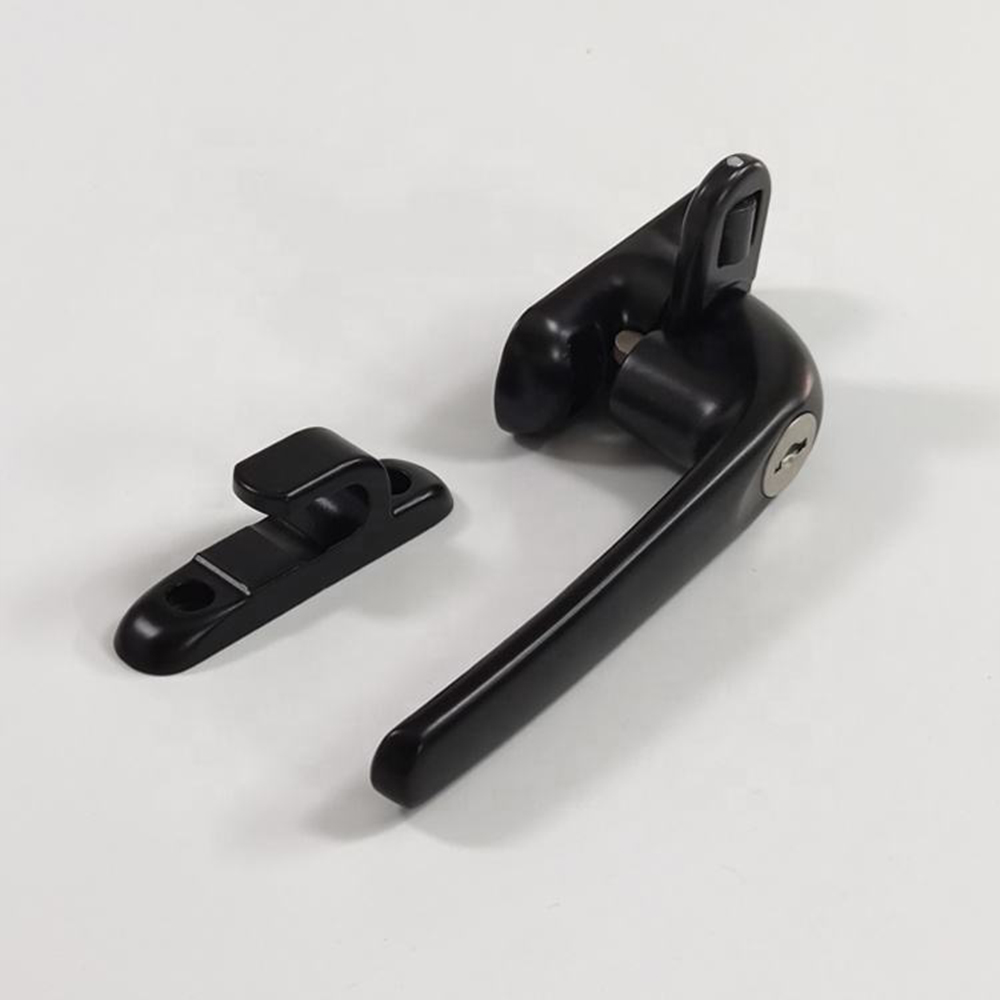
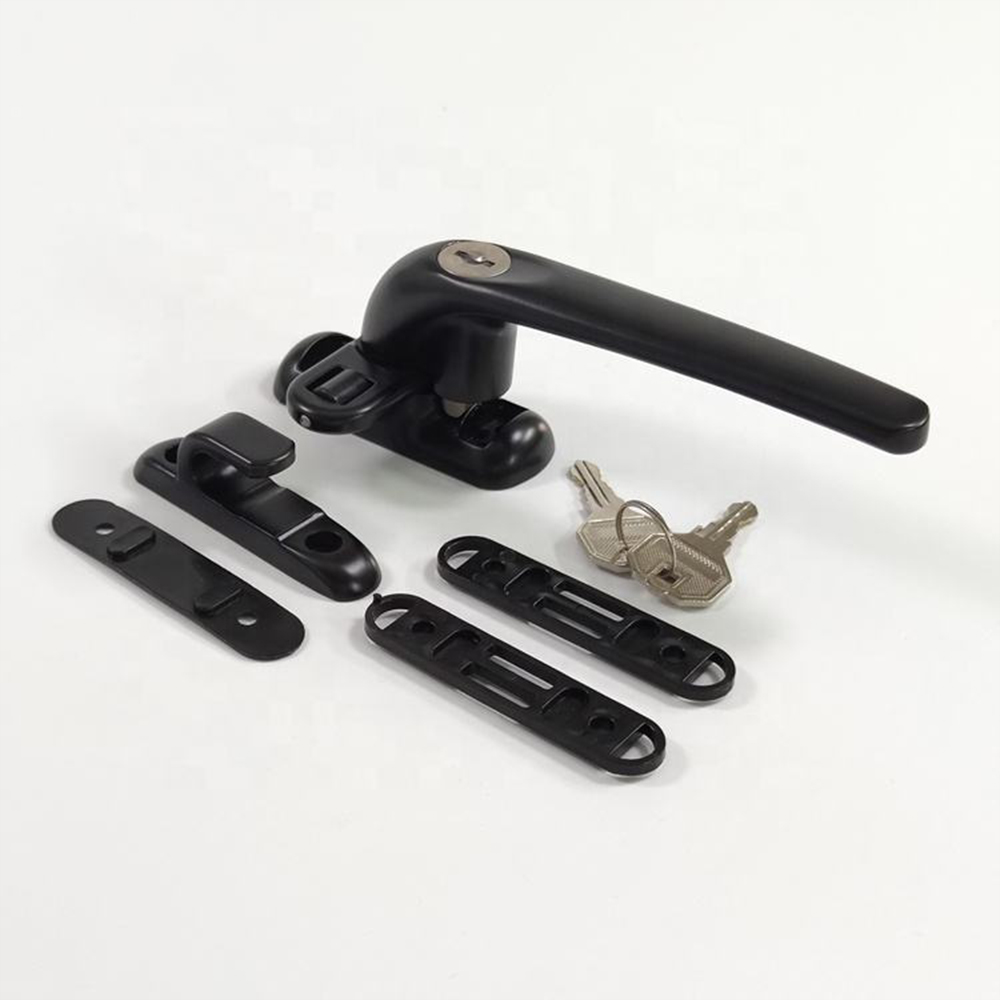
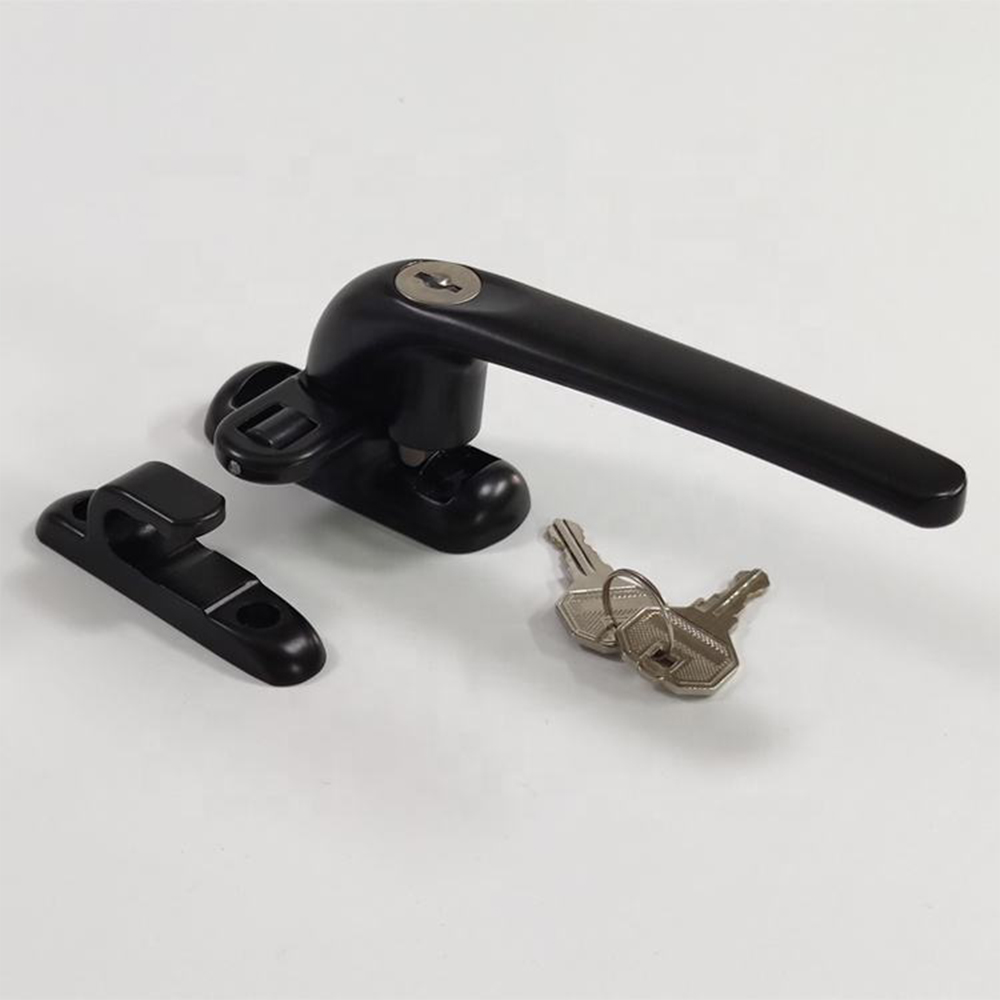
CHIER’s curved-lever sash lock with an exposed sweep cam demonstrates this operating principle.
The visible cam needs to match the keeper geometry, sash overlap and required rotational movement.
Best suited for: Window systems designed around direct cam engagement, including certain aluminium casements and traditional sash-lock arrangements.
Watch out for: Incorrect cam projection, mismatched keeper height and excessive gasket compression.
I would reject any replacement specification describing a cam handle as “universal” without stating its engagement dimensions.
2. Espag Window Handles: Designed for Espagnolette Locking Systems
Espag is short for espagnolette, a mechanism commonly used in modern casement windows.
Instead of operating only one direct latch, an espag handle drives a mechanism that can move several locking points along the sash.
These may include roller cams, mushroom cams, hooks or shootbolts, depending on the hardware design.
This arrangement is common in uPVC windows and also appears in compatible aluminium and timber systems.
Multipoint locking can improve sash restraint and distribute locking engagement, but the number of locking points alone does not establish security performance.
There is another problem worth addressing.
Many buyers assume that every espag handle with a square spindle is interchangeable.
It isn’t.
Some European-style espag configurations commonly use a 7 mm square spindle and 43 mm fixing centres. These are common dimensions, not universal specifications.
Actual spindle length must also match the gearbox position.
A useful real-world example is ERA’s Maxim Universal Multi-Spindle Window Handle. The manufacturer supplies five spindle lengths—9, 15, 30, 43 and 55 mm—with the handle.
One handle family. Five lengths.
That tells us something important: matching the handle design does not automatically solve profile-depth compatibility.
Best suited for: Modern casement windows using a compatible espagnolette or multipoint locking mechanism.
Watch out for: Incorrect spindle length, gearbox compatibility, fixing-centre spacing and operating angle.
3. Fork-Drive Window Handles: The Connection Determines Compatibility
Fork-drive window handles use a flat, slotted or pronged metal connector to transmit movement into a compatible receiving mechanism.
These designs are particularly relevant to certain aluminium window systems.
The rear connection can look deceptively simple.
But a fork that is slightly too wide, too thick or incorrectly spaced may not engage the receiver correctly.
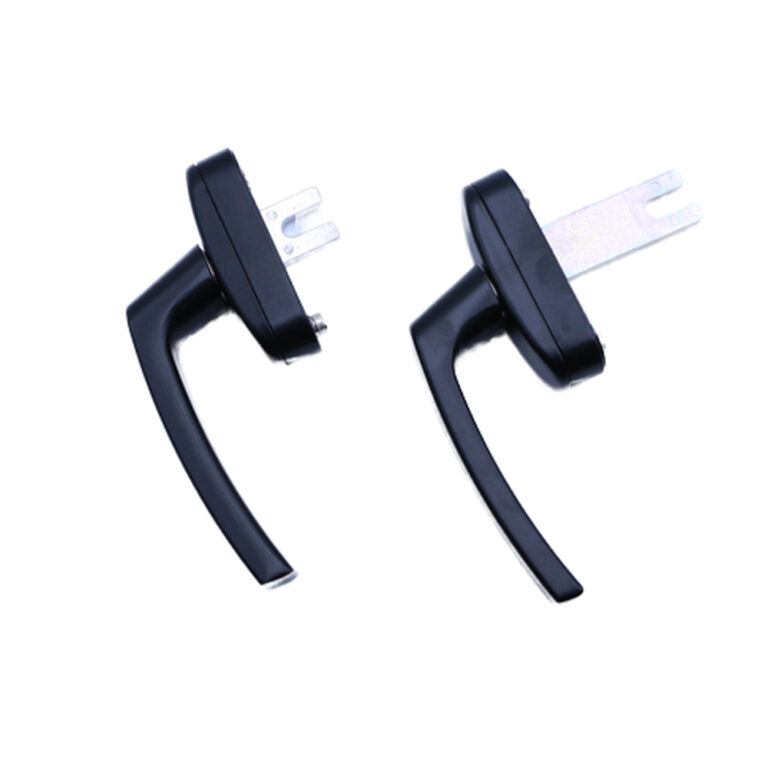
Consider CHIER’s tapered-lever casement window handle with a dual-prong fork.
Its dual-prong connection clearly identifies the drive configuration. However, the product still requires verification of fork width, prong spacing, projection, mounting centres and engagement direction.
I would not approve a fork-drive replacement using only a front-view product image.
The rear connection is the specification that matters.
Best suited for: Aluminium casement systems designed for compatible fork-driven hardware.
Watch out for: Incorrect fork spacing, insertion depth, receiver geometry and lever orientation.
4. Spindle-Drive Window Handles: Familiar but Not Universal
Spindle-drive window handles transfer rotation through a metal shaft into a compatible gearbox or operating mechanism.
Square spindles are especially common.
The difficulty is not understanding how they operate. It is knowing whether the shaft fits the installed system.
CHIER’s square-spindle casement window handle with a slotted connection plate illustrates why the spindle and mounting assembly must be evaluated together.
Three dimensions deserve particular attention:
Spindle section: The shaft’s cross-sectional size and shape.
Spindle projection: The distance from the handle’s rear mounting face to the spindle tip.
Engagement depth: How far the spindle enters the receiving mechanism.
A short spindle may provide insufficient contact to operate the gearbox reliably.
A long spindle may bottom out before the handle base sits flush.
Neither problem can be corrected by tightening the screws harder.
For more technical detail, CHIER explains these failure modes in its guide to window handle spindle length and compatibility.
Best suited for: Window systems using a compatible spindle-operated mechanism, including many uPVC, timber and aluminium casements.
Watch out for: Spindle length, shaft dimensions, gearbox engagement and base clearance.
How to Identify Casement Window Handle Types Before Replacement
Replacing a window handle should begin with the existing mechanical interface.
Not the colour.
Not the catalogue photograph.
And certainly not the assumption that matching screw holes guarantee compatibility.
Step 1: Identify the Locking Mechanism
Examine the sash edge and frame.
A direct rotating latch engaging a nearby keeper suggests a cam-operated arrangement.
A concealed locking rail with multiple cams or bolts may indicate an espagnolette system.
Record the gearbox manufacturer and model number where available.
Step 2: Examine the Drive Connection
With the window safely supported, remove the existing handle if appropriate.
Identify whether its rear connection uses a square spindle, flat blade, fork or another drive design.
Do not force a seized handle or gearbox during inspection.
Step 3: Measure the Critical Dimensions
Record the following before ordering:
Measurement
Why It Matters
Fixing-hole centres
Determines whether the handle can mount correctly
Handle base dimensions
Confirms profile and clearance compatibility
Spindle cross-section
Must match the receiving gearbox
Spindle projection
Controls insertion and engagement
Fork width and spacing
Determines fork-to-receiver fit
Cam reach and keeper position
Controls direct locking engagement
Lever rotation and handing
Must match the intended operating sequence
Use millimetres and state the measurement reference points on technical drawings.
A number without a defined reference surface is not a complete specification.
Step 4: Test the Handle Under Real Operating Conditions
Where safe and permitted by the hardware manufacturer’s instructions, test the mechanism with the sash open before checking normal closed-window operation.
A handle that moves freely with the sash open but becomes stiff when closed may indicate keeper interference, hinge misalignment or excessive gasket compression.
In other words, the handle may not be the defective component.
CHIER’s guide to window handle rotation and gearbox operation explains why the relationship between lever positions and gearbox travel matters.
Security and Safety: What the Evidence Actually Tells Us
Window hardware suppliers often use terms such as “high security” and “child safe” without explaining what the complete window assembly has been tested to achieve.
I find that misleading.
A stronger-looking handle is not automatically a safer window.
Security Depends on the Complete Assembly
England’s Approved Document Q: Security in Dwellings, first published in March 2015 and updated on its publication page in November 2024, addresses resistance to unauthorized entry in new dwellings within its scope.
It considers the robustness of windows and doors together with their appropriate hardware.
That does not mean every espag handle independently complies with Approved Document Q.
For projects requiring recognized security performance, buyers should check the applicable complete-window test evidence, such as PAS 24 documentation where relevant.
Child Safety Requires More Than a Lockable Handle
The U.S. Consumer Product Safety Commission reported in its April 7, 2026 National Window Safety Week release that an estimated 5,600 children aged 12 and under received emergency-department treatment after falling from windows in 2024.
Approximately one-third of those cases required hospitalization.
These figures do not establish that defective window handles caused the incidents.
They do, however, reinforce an important safety distinction: a conventional locking handle is not necessarily a suitable window-opening restrictor or fall-prevention device.
Safety requirements must also account for escape and rescue openings where applicable.
Which Casement Window Handle Should You Choose?
My recommendation is simple: choose the mechanism first and the handle design second.
For a modern uPVC window with an existing espagnolette gearbox, a compatible espag handle with the correct spindle is usually the logical replacement.
For an aluminium system using a fork receiver, match the existing fork-drive interface rather than attempting to substitute a square spindle.
For a window with a direct cam-and-keeper mechanism, confirm cam reach and keeper engagement before considering a replacement.
For OEM manufacturing, I would go further.
Specify the handle, gearbox, keeper positions, fixing dimensions, operating travel and finish as part of one documented hardware system.
A successful sample should establish more than appearance. It should demonstrate repeatable mechanical fit and correct operation in the intended window assembly.
FAQs
What Are the Main Types of Casement Window Handles?
The main casement window handle types include cam-operated handles, espagnolette or espag handles, fork-drive handles and spindle-drive handles, although these terms describe different mechanical characteristics: cam refers to locking action, espag identifies a locking system, and fork or spindle describes the connection transferring movement from the handle.
Some types overlap. An espag handle, for example, commonly uses a square spindle.
What Is the Difference Between Cam and Espag Window Handles?
A cam window handle generally operates a rotating locking component that engages a corresponding keeper, while an espag window handle operates an espagnolette mechanism that can move multiple locking points along the window sash, providing distributed engagement through a gearbox, locking rail and compatible frame-mounted keepers.
The distinction is not absolute because espagnolette mechanisms can also use cam-shaped locking elements.
Are Fork-Drive and Spindle-Drive Handles Interchangeable?
Fork-drive and spindle-drive window handles are generally not interchangeable because they use different mechanical connections: fork-drive handles engage compatible receiving components through a flat or pronged connector, while spindle-drive handles transmit rotation through a metal shaft into a matching gearbox or other operating mechanism within the sash.
Interchangeability requires explicit system compatibility, not merely matching mounting holes.
How Do I Choose the Correct Replacement Casement Window Handle?
The correct replacement casement window handle must match the existing locking mechanism, drive interface, mounting-hole centres, spindle or fork dimensions, operating direction and available clearance, while allowing the sash to close and lock properly without excessive force, mechanical interference or incomplete engagement of the window’s locking points.
When specifications are unavailable, inspect the original handle and request dimensional confirmation before ordering.
Your Next Steps: Get the Handle Specification Right
A casement window handle is not just a lever attached to a frame. It is the operating component of a mechanical assembly.
Cam, espag, fork and spindle-drive systems each have valid applications, but there is no universal replacement that suits every window.
Before placing an order, confirm the locking mechanism, connection dimensions and operating requirements.
For OEM and wholesale buyers, insist on approved technical drawings and sample fitment before production.