التوريد العالمي مقابل التوريد الإقليمي للأجهزة لمصنّعي المعدات الأصلية ذوي الحجم الكبير

A procurement team hits annual volume targets, squeezes unit pricing by 6% to 11%, congratulates itself for “strategic sourcing discipline,” and then gets blindsided by freight shocks, compliance holds, tooling drift, or a supplier that looked robust in PowerPoint and turned fragile the minute forecast volatility showed up. Then everyone suddenly becomes a philosopher about resilience. Why does this keep happening?
For high volume OEMs, hardware sourcing is not a geography question first. It is a risk transfer question. Who absorbs volatility? Who owns buffer stock? Who carries tooling maintenance? Who can hold a ±0.08 mm tolerance for 90 days straight, not just on the golden sample you approved in a conference room?
Global sourcing usually wins on piece price, supplier depth, process specialization, and tooling scale. Regional sourcing usually wins on lead time compression, engineering feedback loops, inventory agility, and political sleep-at-night value. Neither model is inherently smarter. The smart move is matching the sourcing model to the failure mode that would hurt you most.
جدول المحتويات
Most OEMs Are Not Buying Hardware, They’re Buying Error Rates
I’ll say it plainly.
If you are sourcing friction stays, latch locks, rotary locks, flush pulls, soft-close dampers, and window handles at scale, your real cost stack is not the invoice price. It is defect escape, line stoppage exposure, container timing variance, warranty claims, compliance paperwork, engineering revalidation, and the silent killer nobody likes to model: management distraction.
That is why global hardware sourcing still dominates in categories with mature tooling, stable specs, and repeatable finishing processes. Think stainless assemblies, zinc die-cast parts, aluminum handles, stamped components, and cabinet locking systems where suppliers have years of process repetition. In those categories, specialist factories often outperform regional generalists on both consistency and total manufacturability.
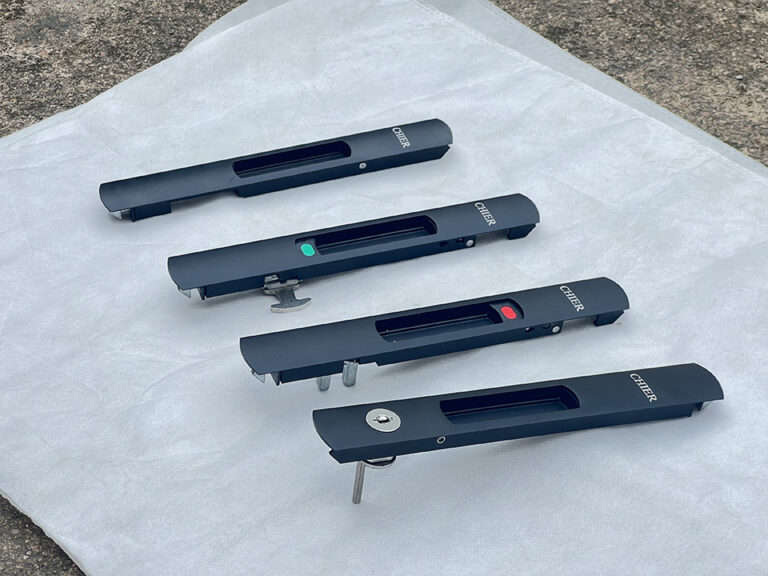
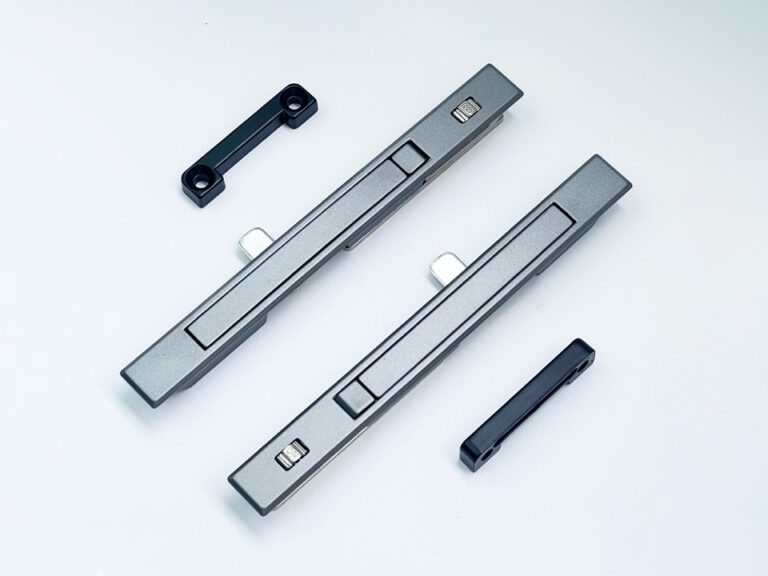
I see this constantly in spec-heavy categories such as مفصلات فتحات تثبيت الاحتكاك الاحتكاكية للنوافذ المصنوعة من المعدات الأصلية و custom aluminum window handle lock programs, where tooling maturity and finish control matter more than patriotic procurement slogans.

Global Hardware Sourcing Wins When Complexity Is Industrial, Not Political
When buyers say “global vs regional sourcing,” they often pretend they are debating values. They are really debating constraints. A mature overseas supplier base can make more sense when your product family requires multi-step finishing, dense subcontractor ecosystems, and component-level customization across several SKUs. That is not ideology. That is factory math.
Look at the evidence. Reuters reported in January 2024 that disruption in the Red Sea hit one of the world’s fastest Asia-Europe shipping lanes, with around 15% of global sea trade moving through that corridor. Freight pain was not theoretical; it was operational.
And yet, despite those shocks, global manufacturing networks did not disappear. They adapted. Apple’s diversification is the cleanest modern signal: Reuters reported in April 2024 that Apple assembled about $14 billion of iPhones in India in fiscal 2024, equal to roughly 14% of global iPhone output. That is not deglobalization. That is selective rebalancing inside a global model.
So, no, the lesson is not “global bad, local good.” The lesson is that concentrated dependency is bad. A diversified global model can still be the best hardware sourcing strategy for high volume OEMs when suppliers are deeply specialized and your annual demand justifies governance discipline.

Regional Hardware Sourcing Wins When Delay Costs More Than Unit Price
A regional supplier that is 8% more expensive per unit can be cheaper in real life if it cuts lead times from 70 days to 18, prevents a line-down event, and allows engineering to fix fit issues in one week instead of one quarter. I’ve watched companies cling to a lower FOB number while bleeding cash through expedited freight, excess safety stock, and preventable change-order chaos.
Regional hardware sourcing makes the most sense when you have one or more of these conditions: your forecast is unstable, your product is still engineering-active, your customers penalize missed delivery windows, or your compliance exposure is rising faster than your procurement systems can keep up.
That compliance point is getting sharper. U.S. Customs and Border Protection’s UFLPA dashboard shows that in fiscal year 2024, CBP stopped 11,778 shipments valued at about $1.78 billion for forced-labor review. For OEMs buying at volume, that is not background noise. That is a sourcing variable with board-level consequences.
So when I hear someone ask how to choose between global and regional hardware sourcing, my answer is blunt: calculate the cost of delay first, then talk about unit price.

The False Choice: Smart OEMs Run Split-Lane Sourcing
The best OEM hardware sourcing teams I know do not “pick a region.” They split the book. Core volume goes to the supplier with the best process economics. The insurance policy goes elsewhere. Sometimes that means 70/30. Sometimes 85/15. Sometimes the backup is not active production at all, but prequalified tooling, approved materials, and a regional pilot cell ready for surge or recovery.
That strategy is especially effective in hardware families with modular overlap. A buyer may centralize high-volume locksets offshore while regionalizing a short-lead accessory line or an urgent design-iteration program. For example, it makes sense to separate stable, repetitive demand from engineering-sensitive categories like wholesale OEM sliding window spring latch lock sets or project-specific مقابض نوافذ بابية سوداء غير لامعة, where finish variation and market-specific aesthetics can create ugly delays if communication loops are slow.
And yes, I prefer this model. Not because it sounds sophisticated. Because it acknowledges that supply chains fail in different ways.

Piece Price Is the Noisiest Metric in the Room
But the spreadsheet almost never includes the full cost of PPAP repetition, sample iteration, non-conformance triage, packaging redesign, customs documentation, MOQ distortion, or the extra inventory you carry because you do not trust your replenishment cadence. And if the spreadsheet does include those line items, they are usually fantasy numbers.
Here is the cleaner comparison:
| عامل القرار | Global Hardware Sourcing | Regional Hardware Sourcing | What Actually Matters for High Volume OEMs |
|---|---|---|---|
| Piece price | Usually lower | عادةً ما تكون أعلى | Savings vanish fast if defects or delays spike |
| المهلة الزمنية | Longer, more variable | Shorter, more controllable | Demand volatility punishes long lead times |
| Supplier specialization | Often deeper | Often narrower | Mature categories benefit from specialist ecosystems |
| الاستجابة الهندسية | Slower unless well-managed | Faster | ECO-heavy programs should bias local or split-lane |
| Freight exposure | أعلى | أقل | Red Sea, Suez, Panama, fuel shocks all change the math |
| Compliance complexity | Higher cross-border burden | Lower cross-border burden | Forced-labor checks, origin rules, documentation risk matter |
| Resilience | Strong if diversified | Strong if proximate | Single-source dependence is the real enemy |
| Best fit | Stable, scaled, repeatable SKUs | Fast-moving, high-penalty, engineering-active SKUs | Match the lane to the failure mode |
What High Volume OEM Sourcing Usually Gets Wrong
First, teams overvalue factory tours and undervalue process data. A polished supplier visit tells me very little if I do not see Cpk history, plating consistency, incoming material controls, and corrective-action behavior over time.
Second, they confuse catalog breadth with manufacturing competence. A supplier offering 2,000 SKUs is not automatically better than a narrower operator with tighter process discipline.
Third, they forget category logic. You should not source a lock assembly, a friction hinge, a recessed pull, and a damper as if they carry identical production risks. They don’t. A مزلاج قفل دوار أسود بمفتاح أسود للخزائن الصناعية has a different tolerance-and-use profile from أجهزة مخمد الإغلاق الناعم للأبواب المعدنية المنزلقة. Treating them the same is how mediocre sourcing teams create expensive surprises.
And fourth, they romanticize “local.” Regional suppliers are not magic. They can be capacity-constrained, technically shallow, or commercially complacent. Paying more for proximity without getting better response time, better quality discipline, or better collaboration is not strategy. It is procurement cosplay.
How to Choose Between Global and Regional Hardware Sourcing
Choose global hardware sourcing when your annual volumes are predictable, your hardware specs are mature, your tolerance stack is proven, and your supplier’s manufacturing system is visibly stronger than closer alternatives. Choose regional hardware sourcing when your forecast moves fast, your product is still changing, and the cost of waiting is worse than the cost of paying more.
If you want a working test, use five filters: volume stability, engineering churn, compliance burden, service-level penalties, and supplier process maturity.
Score each one honestly. Most teams do not. They reverse-engineer the score to justify the supplier they already wanted.
The Better Question Is Not Global vs Regional, But Global for What and Regional for What
You do not need one sourcing doctrine. You need category segmentation. Stable lock bodies, repeatable stamped brackets, mature handle families, and standard window hardware can often live comfortably in a global model with disciplined controls. New-product-introduction parts, region-specific finishes, low-run custom assemblies, and fast-revision components often deserve a regional or dual-lane structure.
The best hardware sourcing strategy for high volume OEMs is usually boring on the surface: category mapping, supplier scorecards, tooling governance, logistics buffers, second-source qualification, and painful honesty about internal forecasting quality. Boring wins. Drama costs money.
الأسئلة الشائعة
What is the difference between global and regional hardware sourcing?
Global hardware sourcing is a procurement model where OEMs buy components from overseas supplier ecosystems to maximize scale, specialization, and price efficiency, while regional hardware sourcing relies on geographically closer suppliers to reduce lead times, improve collaboration speed, and lower logistics and compliance exposure. In practice, the difference shows up in risk distribution, not just distance.
Global sourcing usually offers lower unit costs and broader factory specialization, while regional sourcing usually offers faster replenishment, easier engineering feedback, and lower disruption risk. For high volume OEMs, the right choice depends on how expensive delay, non-compliance, and redesign cycles would be.
What is the best hardware sourcing strategy for high volume OEMs?
The best hardware sourcing strategy for high volume OEMs is usually a segmented approach that assigns stable, high-repeatability parts to the most process-capable low-cost suppliers while keeping engineering-sensitive, time-critical, or compliance-exposed parts in regional or dual-source lanes. One model rarely fits every SKU family.
I would not run a single-lane strategy unless the product line is unusually mature and demand is unusually predictable. Split-lane sourcing, prequalified backups, and category-specific governance beat blanket ideology almost every time.
How do OEMs choose between global and regional hardware sourcing?
OEMs should choose between global and regional hardware sourcing by comparing total landed cost, delay penalties, compliance risk, lead-time variability, engineering churn, and supplier process maturity instead of judging suppliers only by quoted unit price. The decision should start with failure-cost analysis, not with geography bias.
My rule is simple: if line stoppage, missed launches, or compliance holds would do more damage than a higher unit price, lean regional or dual-source. If volumes are stable and the supplier ecosystem is technically stronger overseas, lean global.
Why is unit price a weak sourcing metric?
Unit price is a weak sourcing metric because it ignores the larger economic effects of quality escapes, freight volatility, customs delays, excess inventory, engineering iteration, and management overhead, all of which can erase nominal savings and make a “cheap” supplier expensive over a full planning cycle. That distortion gets worse at OEM scale.
I have seen teams save pennies on a lockset and lose dollars on emergency freight and field failures. Cheap on paper is not cheap in operation.
When does regional hardware sourcing outperform global sourcing?
Regional hardware sourcing outperforms global sourcing when OEM demand is volatile, engineering changes are frequent, market delivery windows are unforgiving, or the compliance and logistics burden of cross-border procurement introduces more financial risk than the offshore price advantage can justify. Speed and control win those scenarios.
This is especially true during launches, redesign periods, and market-specific customization cycles. Proximity is valuable when learning speed matters more than factory scale.
If your sourcing model needs less theory and more discipline, start by auditing which hardware families are genuinely stable and which ones only look stable because no one has measured the hidden costs properly. Then build your supplier mix around reality, not procurement theater.