Looking for hardware solutions that meet European / American standards?
Use this guided inquiry modal to move from a generic quote form to a clearer technical conversation. Buyers can choose whether they need pricing, CAD / 3D files, or OEM / ODM support before sharing contact details.
Compatibility-first design across door / window systems
Repeatable production with clear inspection checkpoints
Documentation and change control for long-running programs
Responsive engineering support for fit and field feedback
Most door handle compatibility failures begin when a buyer approves the visible design before confirming the hidden interfaces connecting the lever, spindle, lock follower, cylinder, faceplate, door profile, strike, and keeper.
Why gamble on appearance?
I’ll be blunt: a handle is not a complete operating system. It is one component in a mechanical chain. A beautiful lever that cannot fully retract the latch, lift the multipoint mechanism, clear the frame, or return to horizontal is not “almost compatible.” It is the wrong product.
Before comparing finishes in the available door handle options, identify the lock architecture, door preparation, and frame-side hardware. Then compare those findings with the relevant window and door lock systems. That order matters.
Compatibility Is a System, Not a Product Photo
Two lever handles may share the same shape, black finish, and backplate length while using completely different operating interfaces.
One may accept an 8 mm square spindle. Another may use a 10 mm spindle. One backplate may have a 72 mm PZ distance—the center-to-center distance between the lever follower and profile-cylinder opening—while another requires 92 mm. A third may fit the lock but collide with the door frame because its lever projection is too deep.
The visible differences are often minor.
The hidden differences stop installation.
I divide compatibility into five layers:
Door compatibility: material, thickness, stile depth, opening direction, edge preparation, and available internal cavity.
Handle compatibility: spindle size, spindle length, fixing centers, backplate dimensions, spring cassette, and lever clearance.
Lock compatibility: backset, follower, cylinder format, PZ centers, lock-case depth, faceplate, latch orientation, and bolt layout.
Regulatory compatibility: accessibility, emergency egress, fire-door requirements, corrosion exposure, and the standards named in the project specification.
Ignore one layer and the entire set can fail.
The Measurements That Decide Whether the Hardware Fits
For common North American tubular preparations, Schlage identifies a 2-1/8-inch cross-bore and either a 2-3/8-inch or 2-3/4-inch backset. Kwikset lists common door thicknesses of 1-3/8 to 1-3/4 inches, with some products accepting thicker doors through a separate kit. These are useful reference points, not universal dimensions for every lock family.
European and profile-door hardware follows different conventions. HOPPE, for example, lists 8 mm and 10 mm spindle options and 72 mm or 92 mm center distances for different entrance, corridor, interior, and security sets. A buyer who writes only “standard Euro handle” has not written a usable specification.
Compatibility check
What to measure or confirm
Common reference examples
Typical failure when wrong
Door type
Timber, steel, aluminum, uPVC, composite, glass, hinged, sliding, or lift-slide
Profile doors usually have limited stile depth
Lock case will not enter the stile
Finished door thickness
Measure the complete finished leaf
35–45 mm is common for many residential sets; product ranges vary
Screws or spindle are too short or too long
Backset
Door edge or faceplate to spindle/follower centerline
60 mm and 70 mm; 2-3/8 and 2-3/4 inches
Handle sits in the wrong position
Main bore or mortise
Diameter, shape, depth, and position
54 mm or 2-1/8 inches is common for certain tubular locks
Trim will not cover or enter the preparation
PZ or center distance
Spindle center to cylinder or keyhole center
72 mm and 92 mm are common catalog options
Cylinder opening and backplate do not align
Spindle/follower
Cross-section, size, length, and engagement
8 mm and 10 mm square spindles are common examples
Lever turns without operating the lock
Fixing centers
Center-to-center distance between mounting screws
Must match the lock and backplate drawing
Screws strike the lock case or miss the holes
Faceplate
Width, length, thickness, corner radius, and screw pattern
Flat, radiused, square-ended, or rounded
Faceplate stands proud or leaves an exposed cutout
Handing
Door swing, hinge side, secure side, and lever rotation
Use a diagram rather than relying only on LH/RH labels
Latch bevel or lever orientation is reversed
Keeper layout
Strike position, box depth, bolt spacing, and projection
Especially important for hook, roller, pin, and shoot-bolt systems
Door closes but will not lock smoothly
Clearance
Lever projection, frame rebate, gasket, glazing bead, and adjacent hardware
Check both open and closed positions
Lever hits the frame or traps fingers
These values are reference examples. They are not permission to assume.
A Yale YDL325S smart interior lock, for instance, lists a 60–70 mm backset and a 35–60 mm door-thickness range. That does not mean another Yale model—or a visually similar product from another factory—uses the same preparation. Model-specific data always wins.
Measure Backset from the Correct Reference Point
Door backset measurement sounds simple until different teams measure from different surfaces.
For a tubular latch, backset normally runs from the door edge to the centerline of the main bore. For a mortise or multipoint lock, the drawing may define it from the faceplate surface to the spindle-follower center. A decorative edge cap, rebated door, or proud faceplate can create a measurable error.
Do not write “approximately 60 mm.”
Write the measured value, reference surface, tolerance, and unit. A useful drawing note looks like this:
Backset: 60.0 mm, measured from the outer surface of the installed faceplate to the center of the 8 mm follower, tolerance ±0.5 mm.
That sentence can prevent an entire batch dispute.
Measure Door Thickness at More Than One Point
Measure the finished door near the lock position, not at a random corner.
Composite skins, metal wraps, decorative panels, seals, and manufacturing variation can change the local thickness. Record at least three readings when the project involves old doors, handmade doors, or mixed production batches.
Then ask whether the quoted spindle and through-bolts cover the minimum and maximum measured thickness. A spindle that barely enters the opposite handle may work during a tabletop test and fail after the fixings are tightened.
Confirm PZ Centers and Fixing Centers Separately
PZ distance and fixing centers are not the same measurement.
PZ describes the relationship between the handle follower and the keyhole, thumbturn, or profile-cylinder center. Fixing centers describe the screw locations holding the handles or escutcheons together. Matching one does not guarantee the other.
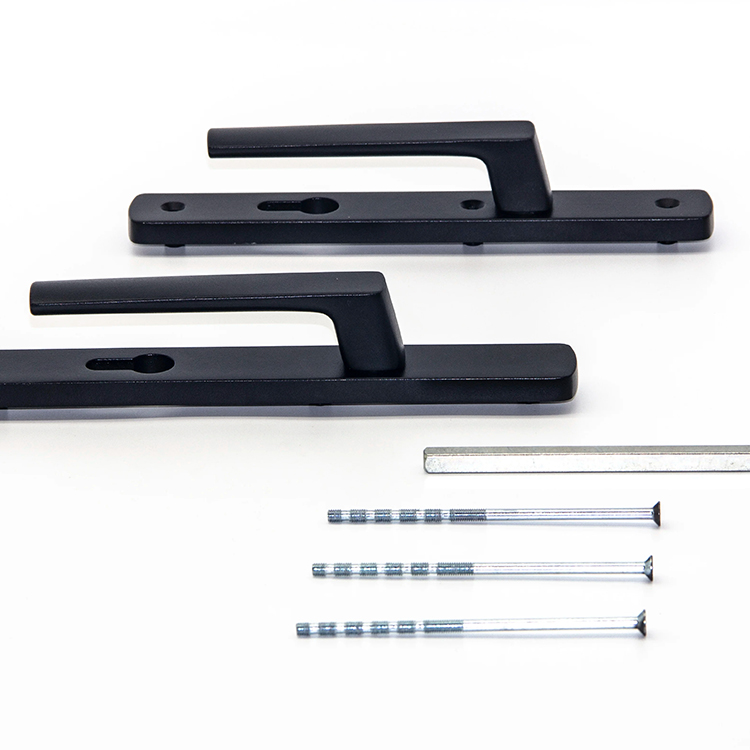
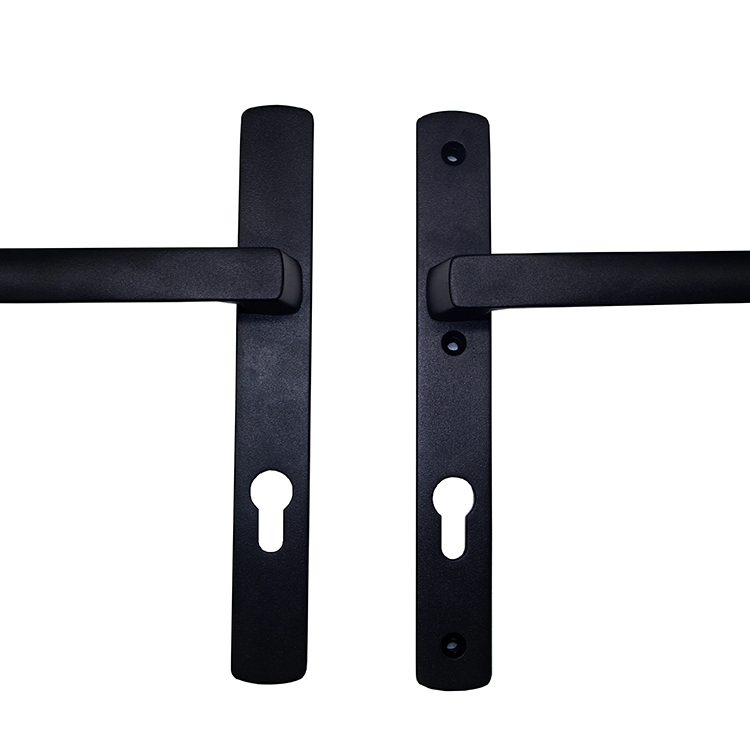
The site’s narrow-backplate lever set with a Euro-cylinder cutout illustrates the point: the lever, cylinder opening, square-spindle hub, spring cassette, backplate, and mounting positions must be treated as one coordinated geometry—not independent visual features.
Match the Lock Architecture Before Choosing the Handle
Tubular and Cylindrical Locksets
Tubular and cylindrical products are often sold as easy replacements because many residential doors use familiar bore patterns.
Sometimes they are easy.
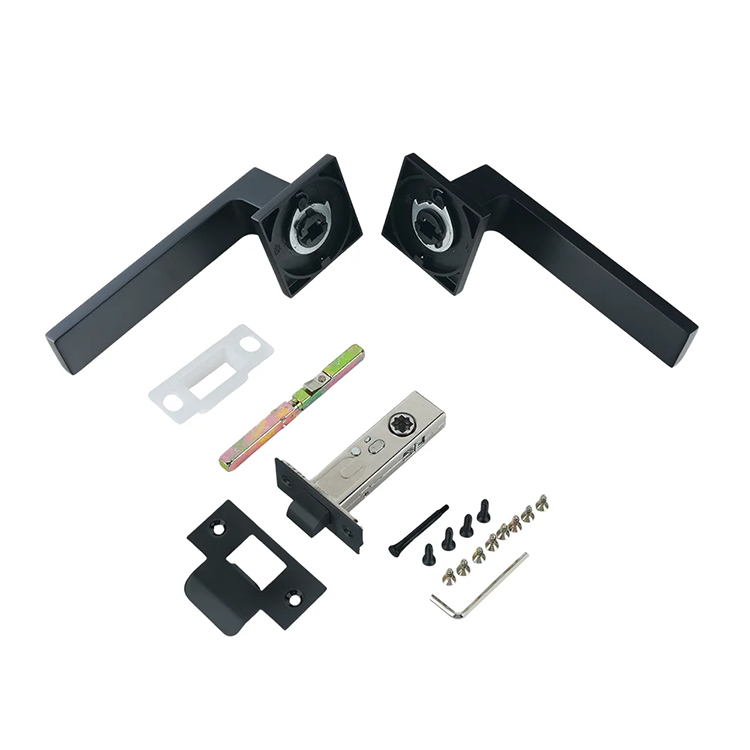
But “standard preparation” still does not answer every question. Check the latch faceplate style, bore diameter, backset, door thickness, rose diameter, screw orientation, latch bevel, privacy-release position, and whether the product requires a full or partial bore.
Also verify function:
Passage
Privacy
Keyed entry
Storeroom
Classroom
Dummy trim
Single-cylinder deadbolt
Double-cylinder deadbolt
A passage lever cannot become an entry lock merely because a cylinder-shaped opening appears on the trim.
Mortise and Multipoint Locks
Mortise and multipoint systems punish vague orders.
The lock may include a spring latch, deadbolt, hooks, rollers, round pins, shoot bolts, linked rods, or automatic locking elements. The handle may retract only the latch, lift the full mechanism, withdraw all locking points, or interact with a split spindle.
So verify:
Lock-case depth and height
Backset
PZ distance
Follower size
Follower position
Faceplate dimensions
Main-case position
Top and bottom locking-point locations
Bolt type, throw, and projection
Keeper and strike geometry
Handle lift angle
Cylinder type and length
Panic or emergency-exit function, where required
Browse the multipoint door lock range to compare operating layouts rather than comparing bolt count alone. A four-bolt lock and a twin-hook lock can require completely different door routing, keeper preparation, and operating force.
Here is the hard truth: “It has four locking points” is marketing language, not a compatibility specification.
Smart and Electronic Locks
Smart locks add another failure layer because mechanical fit is only the beginning.
You still need the correct backset, door thickness, spindle or tailpiece, bore preparation, latch direction, frame alignment, and interior clearance. Then you must check power source, cable routing, radio protocol, mobile-app availability, access-control integration, audit requirements, emergency override, and behavior during battery or power failure.
A larger exterior keypad can also interfere with weather seals, decorative trim, glass cutouts, or narrow aluminum stiles.
And no, an app cannot correct a misaligned keeper.
Accessibility, Egress, and Fire Ratings Are Compatibility Questions
Hardware can fit the holes and still be wrong for the building.
Under the U.S. ADA requirements for covered accessible doors, operating hardware must allow one-hand use, avoid tight grasping, pinching, or wrist twisting, operate with no more than 5 lbf, and generally sit 34 to 48 inches above the floor. The U.S. Access Board’s door and gate guidance specifically identifies lever-shaped handles and U-shaped pulls as accessible examples.
This is enforceable, not decorative advice. In the 2016 Vinarc LLC compliance agreement, the U.S. Department of Justice addressed replacement doors whose lock hardware had been installed too close to the finished floor. A product can therefore match the lock case yet remain incompatible with the project’s legal requirements.
Fire-rated openings require equal discipline. A CPSC recall involving about 8,000 Best Access Systems electronic locks covered IDH Max™, B.A.S.I.S.® G, and B.A.S.I.S.® V cylindrical and mortise products used in locations including schools, hospitals, and university dormitories. The remedy differed for non-rated, 20-minute, and 3-hour fire-rated applications.
The lesson is uncomfortable: a lock model cannot be separated from its installation condition.
Egress deserves the same attention. In 2010, the CPSC recalled roughly 6,500 connector kits used with Sonitrol ACCESS4-S and ACCESS4-SULC four-door control modules after three connector-failure reports. The EB560-marked two-pin, eight-pin, and 17-pin connectors could prevent a door from being unlocked from the inside, creating an entrapment hazard during an emergency.
Cheap assumptions become expensive.
The Pre-Order Checklist I Would Put on Every Purchase File
Do not release a production order until the following items are documented.
Door and Frame Information
Door material and construction
Door profile or stile cross-section
Finished door thickness, including minimum and maximum readings
Frame material and profile
Inward or outward opening
Hinge side
Secure side and escape side
Single-leaf or double-leaf configuration
Fire rating, smoke requirement, or emergency-exit classification
Gasket, rebate, glazing bead, and nearby hardware clearances
Handle Information
Handle type: lever, pull, knob, recessed, lift-slide, or panic trim
Rose or backplate dimensions
Lever projection and return
Spindle shape and size
Required spindle length
Fixing centers
Through-bolt size and length
Spring cassette or unsprung configuration
Handing or lever orientation
Cylinder, keyhole, or privacy-turn cutout
Required finish and approved color reference
Lock and Keeper Information
Lock type: tubular, cylindrical, mortise, rim, or multipoint
Backset
PZ or handle-to-cylinder centers
Follower dimensions
Lock-case depth and height
Faceplate dimensions
Latch type and orientation
Deadbolt or locking-point layout
Bolt throw and projection
Keeper, strike, and box dimensions
Cylinder type and cylinder length
Required keying arrangement
Panic, split-spindle, automatic-locking, or access-control function
Approval Evidence
Dimensioned product drawing with revision number
Door and frame section drawing
Front, rear, edge, and installed-condition photographs
Physical reference sample when replacing an existing product
Approved finish sample
Installation test on the actual door and frame
Repeated latch, lock, unlock, and return test
Packaging and part-identification approval
Written record of any deviation from the original specification
For repeat production, the approved sample and controlled drawing should remain the reference—not a photograph copied from an old quotation. CHIER’s quality-control and hardware testing process includes dimensional, finish, functional, and batch inspection considerations that should be connected to the approved application data.
Hard Truths Buyers Usually Learn After the First Bad Sample
“Universal” Usually Has Boundaries
Universal may mean two backset positions, several door thicknesses, or reversible handing within one product family.
It rarely means every door.
Ask the supplier to define the exact adjustment range and excluded applications. “Universal” without numbers is a sales phrase.
A Matching PZ Distance Does Not Prove Compatibility
A 92 mm handle can still fail against a 92 mm lock because the spindle size, fixing pattern, backplate width, cylinder projection, spring cassette, or profile clearance differs.
One matching dimension proves one matching dimension.
Nothing more.
Handing Labels Can Create International Confusion
DIN left, DIN right, left-hand reverse, right-hand reverse, hinge-side references, and secure-side references are not always used consistently across markets.
Use a drawing showing:
The viewer’s position
Hinge side
Swing direction
Secure side
Lever orientation
Latch bevel
Pictures beat abbreviations.
A Supplier’s Quotation Is Not Automatically a Fit Approval
If the quotation was prepared from a front-view photograph and an estimated quantity, compatibility has not been confirmed.
I would require a signed or approved drawing listing every fit-sensitive dimension. Otherwise, both parties can later claim that the missing information was “understood.”
It was not.
The Actual Door Is the Final Test Fixture
A bench sample may operate perfectly while the installed system binds because the door sags, the gasket compresses heavily, the keeper sits 2 mm too high, or the profile cavity is narrower than the nominal drawing.
Test the handle, lock, door, and frame together.
That is the assembly the user will operate.
FAQs
How do I know whether a door handle is compatible?
Door handle compatibility means the handle, spindle, fixings, lock follower, cylinder position, door thickness, handing, faceplate, and keeper all match the same door assembly, so the lever retracts the latch, operates every locking point, returns correctly, and allows safe entry and exit without drilling uncontrolled new holes.
Start by identifying the lock type. Then record the backset, PZ distance, spindle size, fixing centers, door thickness, handing, and available clearance. Compare those measurements with a dimensioned manufacturer drawing rather than relying on product photographs.
What is door backset measurement?
Door backset is the horizontal distance from the door edge or lock faceplate to the centerline of the handle spindle, cylinder, or main bore, depending on the lock type, and it determines whether the operating hardware sits in the correct position within the door stile.
Always state the reference surface used. A 60 mm measurement taken from the unfinished door edge is not necessarily equal to 60 mm taken from the installed faceplate surface.
Can any door handle work with an existing lock?
A door handle can work with an existing lock only when its spindle size, follower geometry, fixing centers, PZ or handle-to-cylinder distance, backplate clearance, spring arrangement, rotation direction, and door thickness range match the installed lock case and the prepared holes in the door.
A lever that fits over the spindle may still be incompatible if the screws collide with the lock case, the spring force is wrong, or the backplate obstructs the cylinder.
How should I measure door thickness and spindle length?
Door thickness should be measured across the finished door leaf, including bonded skins or decorative faces but excluding removable trim, while spindle length should be checked against the lock follower depth, handle bases, spring cassettes, and the engagement required on both sides without binding.
Take several door-thickness readings near the lock position. For replacement work, remove the old handle and measure its spindle instead of guessing from the visible projection.
What is the best door handle and lock set?
The best door handle and lock set is the one documented for the exact door material, thickness, preparation, opening direction, security function, accessibility requirement, climate, and regional standard—not the set with the heaviest body, highest price, most features, or broadest claim of universal compatibility.
For a new project, select the lock architecture first and coordinate the handle around it. For replacement work, match the existing preparation unless the project allows controlled machining and revalidation.
Send the Measurements Before You Place the Order
Do not order from the front-view photo alone.
Prepare one package containing the door and frame sections, backset, PZ centers, spindle size, fixing centers, finished thickness, handing diagram, faceplate, keeper layout, required function, finish, quantity, and target market. Add photographs with a steel ruler or caliper visible wherever possible.