Looking for hardware solutions that meet European / American standards?
Use this guided inquiry modal to move from a generic quote form to a clearer technical conversation. Buyers can choose whether they need pricing, CAD / 3D files, or OEM / ODM support before sharing contact details.
Compatibility-first design across door / window systems
Repeatable production with clear inspection checkpoints
Documentation and change control for long-running programs
Responsive engineering support for fit and field feedback
Because a handle that appears perfectly flush in a rendering can still weaken a narrow stile, starve the fingers of usable depth, collide with a pocket-door cavity, or force users to fight a badly tuned roller, lock, and seal package.
So what exactly are you buying?
The honest answer is not simply “a sliding door handle.” You are buying an interface between the hand, the moving panel, the lock, the frame, the track, and the surrounding wall. Get one interface wrong and the elegant handle becomes an expensive complaint generator.
My blunt view is that flush hardware is oversold. Architects love it because it disappears. Marketing teams love it because it photographs well. But users do not operate photographs. They operate complete doors, sometimes while carrying bags, wearing gloves, dealing with reduced grip strength, or trying to move a panel that has become harder to slide after installation.
Flush, recessed, and surface-mounted sliding door handles each have a legitimate place. None is universally “best.”
The Naming Problem Most Buyers Miss
Here is the first industry trap: flush, recessed, and surface-mounted are not always three mutually exclusive categories.
Flush describes projection. The visible face of the handle sits level, or nearly level, with the door surface.
Recessed describes geometry. Part of the handle, finger pocket, lock body, or grip cavity sits inside a machined opening in the panel.
Surface-mounted describes installation. The handle body is fixed onto the door face rather than installed inside a deep cutout.
A handle can therefore be both recessed and flush. A recessed pull can also have a rim projecting several millimetres beyond the panel. And a slim surface-mounted handle may have less projection than a badly detailed “flush” lock with a proud faceplate.
This terminology causes real purchasing errors. One supplier quotes a flush pull based on visual appearance. Another interprets “flush” as zero projection. A third supplies a recessed cup with a 4 mm rim. Everyone believes they quoted the same product.
They did not.
For serious sourcing, replace vague labels with drawings. Define maximum projection, cutout length and width, recess depth, corner radius, panel thickness, fixing centres, fastener type, hand clearance, lockcase position, and required operating force. CHIER’s range of OEM sliding door handles and flush pulls shows how many different structures can sit under the same broad product name.
Flush vs Recessed vs Surface-Mounted Sliding Handles at a Glance
Handle type
What the user touches
Door preparation
Grip quality
Best applications
Main risk
Flush sliding door handle
Shallow cup, edge, plate, or deployable pull near the panel surface
Precise routing, stamping, or profile preparation
Low to moderate unless the grip deploys
Pocket doors, bypass doors, minimalist interiors, narrow clearance zones
Poor finger access or excessive operating effort
Recessed sliding door handle
Finger pocket or pull positioned inside the panel face
Cutout with enough material around the opening
Moderate when depth and edge geometry are correct
Wardrobes, interior sliders, aluminum panels, concealed-hardware systems
More moving parts, tolerance sensitivity, spring or pivot wear
That table is the starting point, not the specification.
A 25 kg wardrobe panel and a 180 kg glazed lift-slide door may both be called “sliding doors,” but their handle requirements have almost nothing in common. Panel mass, roller efficiency, gasket compression, wind pressure, lock engagement, and user frequency change the answer.
Where Flush Sliding Door Handles Win—and Where They Fail
Flush sliding door handles are the right answer when projection itself creates a functional problem.
A pocket door must travel into a wall cavity. A bypass panel must pass another panel without a projecting handle striking it. A compact wardrobe cannot sacrifice aisle clearance. In these cases, keeping the handle face level with the panel is not merely an aesthetic choice.
It is geometry.
A purpose-built recessed flush sliding door lock and handle can combine a clean face with locking operation, but only when the panel provides enough cavity depth and the deployed grip remains usable.
The hard truth about shallow flush pulls
A shallow finger cup does not generate mechanical advantage. If the sliding system has high rolling resistance, weather-seal drag, poor alignment, or an aggressive soft-close spring, the user compensates by curling fingertips harder against a small edge.
That is bad design.
The handle often receives the blame, but the real fault may sit in the rollers, track, lock, panel alignment, or gasket. A flush pull works best when the entire door already moves easily.
I would reject a flush handle sample when:
Fingertips contact the bottom of the pocket before forming a stable grip.
The pull has sharp internal edges or an uncomfortable return lip.
The mortise removes too much material from a narrow aluminum stile.
The lock body, fixing screws, and pull cavity compete for the same space.
The fully open door hides the operating surface inside a pocket or behind another panel.
The user must pinch a small tab before pulling.
The door cannot be opened with one hand under its intended operating load.
Minimalism is not a waiver from physics.
Recessed Sliding Door Handles Offer the Best Middle Ground
Recessed sliding door handles usually offer more usable finger depth than truly flush pulls while maintaining far less projection than surface-mounted hardware.
For interior aluminum sliders, timber pocket doors, wardrobe panels, and cabinet systems, this is often the most balanced format. The handle remains protected from impact, the door face stays visually clean, and users receive a defined pocket rather than a razor-thin edge.
But recess depth is only one part of the grip.
The entry radius, pocket width, internal height, edge thickness, texture, and approach direction determine whether the handle works for different hand sizes. NIOSH-hosted research on cylindrical handles found that handle diameter, hand size, grip force, and contact area interact rather than operating as separate variables. A door pull is not a laboratory cylinder, but the broader lesson still applies: one grip geometry does not serve every hand equally.
Recessed does not mean structurally harmless
Every recess removes material or occupies profile space.
On a timber panel, poor routing can leave thin walls that crack around the fixing points. On an aluminum stile, the pocket may interfere with reinforcement chambers, lockcases, connecting rods, drainage paths, or thermal-break geometry. On a thin composite panel, screws may have almost no useful thread engagement.
This is why I treat the profile section as mandatory purchasing data.
No drawing? No approval.
The supplier should confirm the complete cross-section showing the handle body, fastener engagement, panel wall thickness, lock clearance, edge distance, and allowable manufacturing tolerance. A sample that fits after hand filing is not a production-ready design.
Surface-Mounted Sliding Door Handles Are Often the Most Honest Choice
Surface-mounted sliding door handles project from the panel, and that projection is exactly why they work.
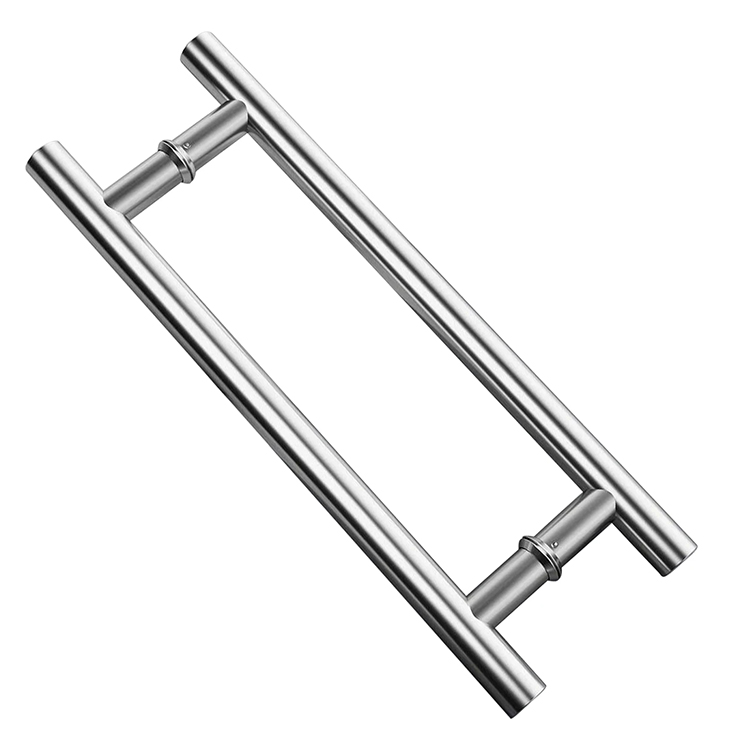
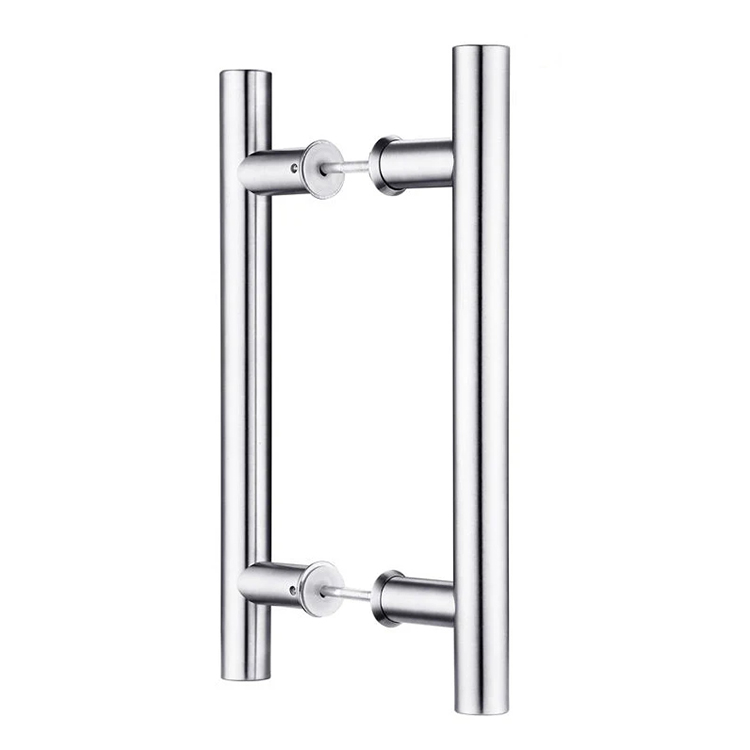
A proper bar pull, offset lever, or lift-slide handle provides visible, predictable purchase. Users can wrap fingers around it, apply force through the palm, and control a heavy panel without searching for a hidden edge.
For heavy exterior sliding doors, commercial entrances, lift-slide systems, and retrofits, I generally prefer a well-engineered surface-mounted pull over a shallow recessed cup. It may look less pure. It will often work better.
Where surface-mounted handles create trouble
Projection becomes a liability when the handle:
Strikes a wall, frame, jamb, or adjacent panel.
Prevents a pocket door from fully retracting.
Reduces clear passage width.
Catches clothing, bags, hoses, or cleaning equipment.
Places fasteners too close to a glass edge.
Creates enough leverage to loosen weak screw bosses.
Exposes screws that invite tampering in public areas.
This does not make surface mounting inferior. It makes clearance analysis mandatory.
And surface hardware has one major retrofit advantage: it can often be installed without routing a large pocket into an existing panel. When the original door structure is unknown, preserving material may be safer than cutting a deep recess based on assumptions.
Accessibility Is an Engineering Requirement, Not a Marketing Claim
A supplier calling a handle “ergonomic” proves nothing.
The U.S. Access Board’s door hardware guidance says accessible door and gate hardware must permit one-hand operation, avoid tight grasping, pinching, or wrist twisting, operate with no more than 5 lbf, and sit 34 to 48 inches above the floor or ground. That equals 22.2 N and approximately 865 to 1,219 mm. The Board also recommends at least 1½ inches of knuckle clearance for bars and pulls.
Notice what the guidance does not say.
It does not say “flush equals accessible.” It does not say “surface-mounted equals accessible.” It evaluates actual operation.
A deep recessed handle might pass the practical test if it supports a loose grip and the door moves easily. A beautiful flush pull might fail if users must pinch its edge. A large surface pull might provide excellent grip but still be positioned incorrectly or require excessive force because the door system is badly adjusted.
Two DOJ cases hardware buyers should read
The Webb County, Texas settlement documented inaccessible knob hardware and doors requiring 8 pounds of opening force. The agreement required one-hand-operable hardware without tight grasping, pinching, or wrist twisting, and required affected doors to be reduced to no more than 5 pounds of opening force.
The International Spy Museum settlement went further. Investigators recorded doors requiring 10, 13, 14, and 15 lbf, alongside stall hardware that required tight grasping and wrist twisting. The remediation covered both opening force and hardware geometry.
These are enforcement case studies, not evidence that one mounting style automatically complies. They prove something more useful: regulators can examine the complete interaction, not merely the handle catalogue.
Safety Problems Begin Where the Marketing Photo Ends
A protruding handle can snag. A shallow recess can pinch. A narrow edge pull can concentrate force on one finger. A poorly aligned door can make every grip feel worse.
There is no national dataset proving that surface-mounted sliding handles cause a defined percentage of hand injuries, and anyone claiming otherwise should show the data. Still, the broader cost of hand hazards is not theoretical.
The CDC and NIOSH reported in October 2024 that mining hand and finger injuries had caused 82,725 days away from work, represented 18% of lost workdays in the reviewed data, and occurred at a rate of 6 per 1,000 full-time-equivalent miners. The index finger accounted for 28.8% of injuries in one cited dataset. This is mining evidence, not door-hardware epidemiology, but it explains why finger clearance, sharp edges, crush zones, and snag points deserve engineering attention rather than decorative review. Read the CDC/NIOSH data.
My test is simple: operate the door with bare hands, gloves, wet hands, one hand occupied, reduced finger extension, and deliberately poor hand placement.
Then watch.
Where do the fingers go when the user misses the ideal grip? What happens during closing? Can the hand enter a narrowing gap between two panels? Does the handle move toward a jamb, wall pocket, or fixed glass edge?
Good hardware survives imperfect users.
The Hidden System Around Every Sliding Door Pull Handle
The best sliding door handles are selected as part of a system. The handle cannot correct a bad system after the purchase order has been signed.
Panel and profile geometry
Check door thickness, stile width, internal chambers, reinforcement, glass bite, edge distance, screw access, lockcase depth, drainage paths, and thermal-break location.
For flush and recessed handles, the cutout drawing matters as much as the front elevation. Ask for a section view. Better yet, request a STEP file and place it inside the complete door model.
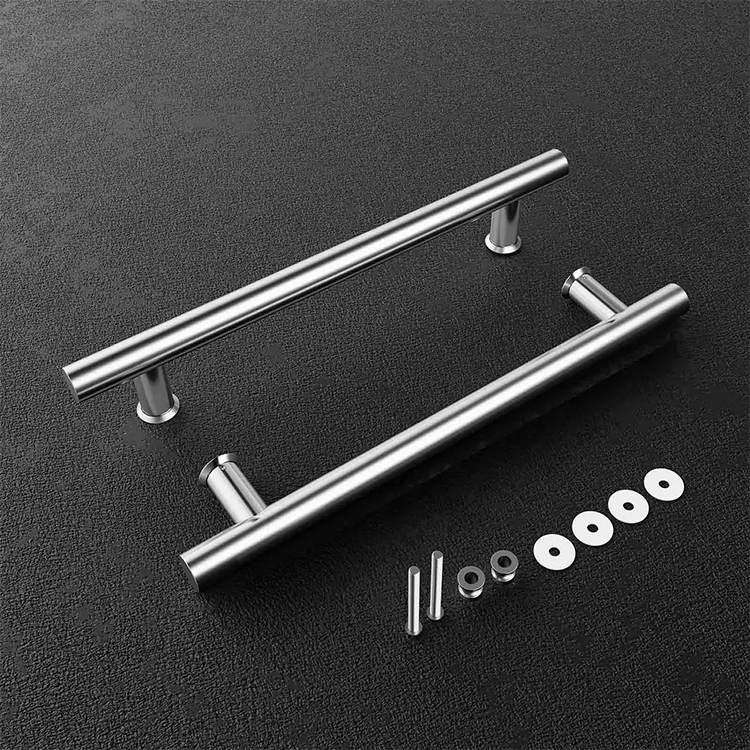
For surface-mounted handles, check fixing-centre tolerance, screw engagement, back-to-back bolt length, reinforcement plates, and whether the applied leverage can distort the panel skin.
Lock and handle interference
A sliding handle may share space with a hook lock, mortise lock, thumbturn, cylinder, connecting rod, or keeper system. Even a 2 mm positional error can create rubbing, limited lock travel, or a screw colliding with an internal component.
Do not approve the handle and lock separately.
A locking flush pull should be tested with the actual lock body, spindle or actuator, keeper, panel profile, and installation screws. Product photos conceal these interfaces.
Track resistance and soft-close force
A soft-close mechanism changes what the handle must do. It adds controlled resistance before pulling the panel into its final position.
That can improve safety and perceived quality, but a damper that is oversized, misaligned, or installed with excessive spring resistance can make a shallow flush pull miserable to use. Match the handle evaluation to the actual sliding door soft-close damper and panel weight rather than testing each part alone.
Finish, corrosion, and cleaning exposure
Handle type also changes where moisture, salts, skin oils, and cleaning chemicals collect.
A recessed cup can trap water and dust. A surface pull exposes fasteners and base joints. A flush lock may conceal dissimilar metals inside a damp cavity. Aluminum naturally forms an aluminum oxide film, Al₂O₃, but that does not protect a weak coating, contaminated pretreatment, carbon-steel screw, or galvanically mismatched assembly from every environment.
As of 2026, ASTM B117-26 defines the current ASTM practice for operating salt-spray apparatus. But salt-spray hours are not a direct field-life promise. The report must identify the substrate, finish system, assembled condition, exposure time, acceptance criteria, and actual product model.
CHIER’s quality control and testing process takes the right approach by tying dimensional checks, operating torque, strength, cycle life, finish evaluation, corrosion exposure, and traceability to the specific hardware program rather than relying on a generic “passed” claim.
How to Choose Sliding Door Handles Without Guessing
Start with the application, not the finish board.
Choose a flush handle when:
The door must enter a pocket, pass another panel, preserve a narrow circulation zone, or maintain a near-zero-projection architectural face. Confirm that the door already moves with low resistance and that the handle provides enough finger access.
Choose a recessed handle when:
You need controlled projection but want more grip than a shallow flush plate can provide. It is often the best compromise for interior sliders, wardrobes, aluminum panels, and concealed-hardware systems with adequate profile depth.
Choose a surface-mounted handle when:
Grip, leverage, easy retrofit, or heavy-panel control matters more than visual concealment. It is usually the safer starting point for exterior patio doors, lift-slide systems, frequent-use commercial openings, and doors operated by a wide range of users.
Reject all three options when:
The door force is unknown, the profile drawing is missing, the lock has not been selected, the panel structure cannot support the fixings, or the supplier cannot provide a dimensional section.
Yes, reject them.
The wrong moment to discover a handle conflict is after 5,000 finished units have reached the assembly line.
My Specification Rule for Sliding Door Pull Handles
When I review a specification, I ignore the finish image first. I want the mechanical facts.
At minimum, the specification should identify:
Handle type and model revision
Maximum projection from the panel face
Overall length, width, and depth
Required panel cutout and corner radii
Fixing centres and fastener specification
Minimum usable grip or finger-pocket dimensions
Door thickness and profile section
Lock, spindle, cylinder, or actuator interface
Handing and orientation
Panel mass and intended application
Target operating-force requirement
Finish system, color reference, and gloss range
Corrosion-test method and acceptance criteria
Static pull, torque, misuse, and cycle-test expectations
Packaging protection for visible surfaces
Golden sample and change-control process
For custom programs, route these requirements through a documented OEM/ODM handle development program that includes drawing review, sample verification, first-article checks, pilot production, and controlled revisions. A supplier sample is evidence of one sample. It is not proof of repeatable production.
FAQs
What is a flush sliding door handle?
Flush sliding door handles are low-profile pulls whose visible face sits nearly level with the door surface, making them best for pocket doors, bypass panels, narrow clearances, and minimalist interiors where projection must be controlled, provided the recess still gives users enough finger access and the door moves with low resistance.
Some flush pulls use shallow finger cups. Others use fold-out levers, edge pulls, or integrated locks. Always define the permitted projection on the technical drawing because “flush” does not consistently mean zero millimetres across suppliers.
What is a recessed sliding door handle?
Recessed sliding door handles are pulls set into a machined pocket or cutout below the panel face, often with a visible rim or fold-out element, so they provide more purchase than a shallow flush pull while preserving clearance for pocket, bypass, wardrobe, and slim-frame sliding systems.
They require more panel preparation than most surface-mounted handles. The design must preserve stile strength, clear internal lock components, and provide enough depth for comfortable finger access.
When is a surface-mounted sliding door handle best?
Surface-mounted sliding door handles are pulls fixed directly onto the door face, creating positive projection and usually the strongest, easiest grip, which makes them well suited to heavy patio, lift-slide, commercial, and retrofit doors where clearances allow the hardware to remain exposed without striking frames, walls, or adjacent panels.
They are less suitable for doors that must disappear fully into wall pockets or pass closely behind another panel. Projection, fastener strength, and collision clearance must be checked on the complete assembly.
What is the best sliding door handle?
The best sliding door handle is the mounting style that matches the panel structure, operating force, accessibility target, available clearance, lock geometry, and maintenance plan, rather than the option that looks cleanest in a rendering or costs least on a supplier quote before the complete door assembly is tested.
For light pocket doors, that may be a recessed flush pull. For a heavy lift-slide door, it will more often be a substantial surface-mounted lever or pull. The application decides.
Are flush pull handles ADA compliant?
Flush pulls can meet accessibility requirements only when the complete hardware and door assembly permits one-hand operation without tight grasping, pinching, or wrist twisting, keeps the operable part within the required reach range, provides usable finger or knuckle clearance, and stays within applicable operating-force limits for the project.
The mounting label alone does not establish compliance. Test the actual handle, lock, and installed door together against the applicable accessibility standard and local code requirements.
Send the Door Profile Before You Approve the Handle
Do not approve sliding door handles from a front-view photograph.
Send the profile section, door thickness, panel mass, opening type, lock body, track arrangement, available clearance, target handle height, finish requirement, annual quantity, and destination market. Then request a sectional drawing showing the handle, screws, lock, reinforcement, and surrounding panel material.
Compare suitable models in the door and window handles catalogue, shortlist the mounting format, and submit the complete application for engineering review before authorizing tooling or mass production.
The decision is not flush versus recessed versus surface-mounted in isolation.
It is whether the chosen handle still fits, grips, locks, clears, and operates correctly when the entire sliding door becomes real.