Looking for hardware solutions that meet European / American standards?
Use this guided inquiry modal to move from a generic quote form to a clearer technical conversation. Buyers can choose whether they need pricing, CAD / 3D files, or OEM / ODM support before sharing contact details.
Compatibility-first design across door / window systems
Repeatable production with clear inspection checkpoints
Documentation and change control for long-running programs
Responsive engineering support for fit and field feedback
The casement window hardware industry routinely mixes terms describing the locking mechanism with terms describing the handle-to-lock connection, leaving buyers comparing cam, espag, fork and spindle products as though they were four cleanly separated families when, mechanically, they often overlap.
Why does that matter?
Because two casement window handles can share the same finish, lever length and fixing-hole spacing yet remain completely incompatible behind the backplate.
Here is my blunt assessment: appearance should be the last compatibility check, not the first.
A spindle-driven handle may operate an espagnolette system. A fork-drive handle may also control a concealed multipoint lock. A cam handle may operate one local locking point or connect to a tandem lock bar. The label on the carton rarely tells the whole story.
The Classification Problem Most Buyers Miss
The four terms in this guide do not all describe the same thing:
Cam usually describes the locking action or the component that engages the keeper.
Espag describes an espagnolette locking architecture, normally using a concealed rail with multiple locking points.
Fork drive describes the physical interface connecting the handle to the mechanism.
Spindle drive also describes the physical interface, usually a square metal pin entering a gearbox.
That distinction is not academic.
It decides whether the handle engages properly, whether the sash receives enough compression, whether the lever stops at the intended positions and whether the window locks at all.
ERA separates modern casement hardware into espagnolette, cockspur, traditional timber and aluminium fork-drive formats. It also states that espagnolette handles are widely specified for modern PVCu casement windows, while fork-drive handles are available for aluminium profiles. ERA’s casement window handle range shows why frame material alone still does not provide enough information to order a replacement.
The hard truth? “It looks the same” is not a specification.
Cam, Espag, Fork and Spindle Handles Compared
Handle type
What the lever drives
Typical applications
How to identify it
Main advantage
Common failure or ordering risk
Cam handle
A rotating cam, hook, tongue or connected lock bar
Aluminium casements, project-in/project-out windows, older commercial systems
Projecting locking nose, cam or profile-specific connection behind the handle
Simple action and strong local compression
Wrong cam offset, keeper position, handing or reach
Espag handle
An espagnolette gearbox and concealed multipoint rail
Modern uPVC, timber and some aluminium casements
Square spindle entering a central gearbox; lock strip contains rollers, mushrooms, hooks or shootbolts
Multiple locking points from one lever
Wrong spindle length, gearbox orientation, screw centers or lock-strip compatibility
Fork-drive handle
A flat, slotted or dual-prong fork entering a receiving mechanism
Aluminium casement and awning profiles
Flat blade or fork projecting from the rear of the handle
Compact interface suited to narrow profiles
Fork width, thickness, projection and slot geometry are often system-specific
Spindle-drive handle
A square spindle entering a gearbox or rotating receiver
uPVC, timber, aluminium and mixed-profile systems
Square metal pin projecting from the rear hub or backplate
Familiar, measurable and widely used interface
Correct square size but wrong length, engagement depth or rotation
The table is simple. Procurement is not.
A professional buyer still needs the profile drawing, lock drawing, rear-interface dimensions and installed clearances before approving a handle.
CHIER’s casement handle collection reflects this interface-first approach, separating spindle, fork-drive and concealed-fixing configurations while asking buyers to verify mounting centers, lever rotation, handing and sash clearance.
Cam Window Handles: Simple Hardware With Unforgiving Geometry
How a cam handle works
A cam window handle rotates a shaped locking element so it moves behind, over or against a keeper. Depending on the system, the handle may operate a single local cam or transfer movement into a tandem lock bar serving another locking point.
Fewer parts. Less forgiveness.
The cam’s reach, offset and closing path determine how it approaches the keeper. A cam that sits 2 mm too far out may fail to pull the sash onto the gasket. One positioned too deep may make the lever stiff, distort the keeper or encourage installers to force the sash shut.
AmesburyTruth’s 27 Series is a useful product-specific example: the manufacturer lists up to 150 lb of forced-entry resistance per locking point, depending on the keeper. That does not mean every cam handle carries the same rating. It shows why buyers must evaluate the complete handle, lock and keeper assembly rather than assigning performance to the visible lever alone. Review the official 27 Series specification.
Where cam handles make sense
I would consider a cam-style handle when:
The window profile was designed around a direct or tandem cam lock.
A compact, profile-mounted solution is needed.
The keeper geometry and sash overlap are already controlled.
Replacement continuity matters more than converting to a different lock architecture.
I would reject one immediately if the supplier could not confirm cam reach, keeper position, handle handing and locked-angle geometry.
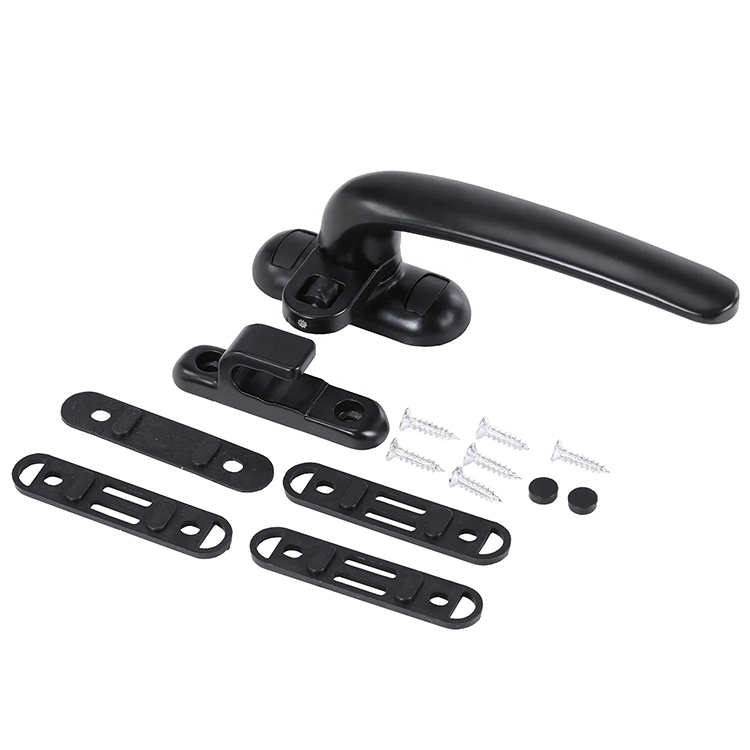
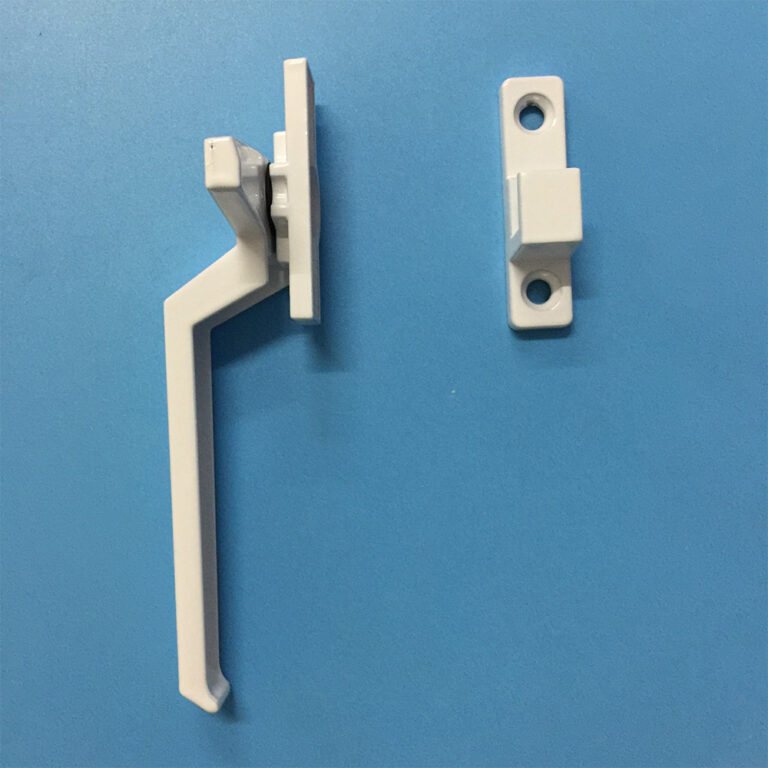
A product such as CHIER’s arched window handle with a projecting latch tongue illustrates the visible tongue-style connection buyers may encounter in profile-specific window assemblies. Similar appearance does not prove identical engagement.
Espag Window Handles: Multipoint Locking Behind a Clean Lever
What “espag” actually means
Espag is short for espagnolette. In a modern casement window, an espag handle normally turns a spindle connected to a gearbox, which moves a concealed metal rail fitted with locking elements such as rollers, mushroom cams, hooks or shootbolts.
ASSA ABLOY describes its inline espag handles as suitable for concealed espagnolette systems, while its cranked versions use a rear spindle connected to a multipoint lock. See the official inline espag handle.
The handle is only the control device. The locking performance comes from the system.
This is where cheap replacement advice falls apart. A buyer sees two screw holes and a square spindle, then assumes compatibility. But the following variables can still kill the fit:
Spindle length
Square spindle size
Fixing-hole centers
Gearbox depth and follower position
Handle rotation direction
Inline or offset lever geometry
Locking-button position
Required egress function
Lock-strip condition
Mila’s official window handle catalogue states that espag spindle lengths generally range from 9 mm to 55 mm, depending on the fabricated profile system. ERA sells a replacement pack with 9, 15, 30, 43 and 55 mm spindle options. Those numbers alone explain why “standard spindle” is dangerous language. ERA’s universal multi-spindle handle is designed specifically to cover several common replacement depths.
Fork-Drive Window Handles: The Aluminium Profile Specialist
What sits behind the lever
A fork-drive window handle uses a flat blade, slotted fork or pair of prongs to engage the receiving mechanism inside the sash profile. The handle rotates, the fork transfers the movement and the concealed mechanism moves into its locked or unlocked position.
It looks basic.
Yet the fork may have its own controlled width, thickness, slot length, prong separation, insertion depth and orientation. Change any one of those dimensions and the handle may wobble, bind or miss the receiver completely.
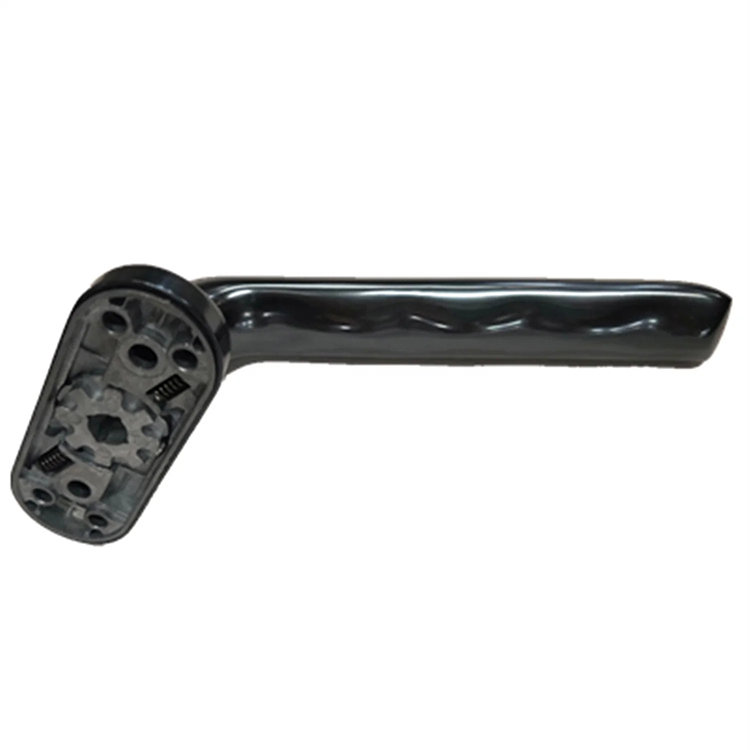
CHIER’s straight-lever casement handle with a slotted flat fork makes the identification point clear: buyers must verify connector width, thickness, slot position, projection and insertion direction, not merely the backplate shape.
Why fork-drive replacements go wrong
Fork handles are commonly associated with aluminium window systems, but “for aluminium windows” remains far too vague for a purchase order.
Profile suppliers may use different:
Fork geometries
Lock body depths
Fixing centers
Base footprints
Handle stops
Rotation angles
Left- and right-handed arrangements
So can one fork handle replace another because both have two prongs?
No.
That is the same as saying two electrical plugs are interchangeable because both contain metal.
Spindle-Drive Handles: Familiar Does Not Mean Universal
How spindle drive works
A spindle-drive handle transfers lever rotation through a square metal pin into a gearbox, lock body or rotating receiver. A 7 mm square spindle is common in several European window hardware systems, but spindle length and engagement depth still vary considerably.
An ERA aluminium handle data sheet, for example, specifies compatibility with a 7 mm square pin and a 70 mm pin length for mechanisms positioned farther from the handle. That is a specific configuration, not a universal rule.
This is the overlap that confuses buyers: many espag window handles are spindle-driven. “Espag” tells us what locking architecture the handle controls. “Spindle drive” tells us how the handle connects to it.
One term cannot automatically replace the other.
CHIER’s square-spindle casement window handle also warns buyers to check the spindle cross-section, projection, insertion orientation, engagement depth, set-screw position and rotation clearance. That is the right level of scrutiny.
The spindle-length trap
A spindle that is too short may barely enter the gearbox. It can work during sampling, then round off or disengage after repeated operation.
A spindle that is too long can bottom out before the handle base seats against the profile. Installers then tighten the screws harder, bend the backplate or cut the spindle without controlling the finished length.
Both errors are avoidable.
How to Identify Casement Window Handle Types
Do not begin with color.
Begin at the rear interface.
1. Photograph the handle before removal
Take clear photographs in the locked, unlocked and open positions. Include the keeper, sash edge and any visible lock rail.
2. Check whether the handle is handed
An inline handle may suit left- and right-hand installations. An offset, cranked or cam handle may not. Record the hinge side and the direction the lever rotates when viewed from inside.
3. Remove the handle carefully
Open any screw covers and support the handle as the screws come out. Do not allow a loose lock body to drop inside a hollow aluminium profile.
4. Identify the rear drive
Look for:
A projecting cam, tongue or hook
A square spindle
A flat slotted fork
A dual-prong fork
A blade connection
A direct mounting hub with a set screw
5. Measure the connection
Use digital calipers where possible. Record dimensions in millimetres:
Spindle width
Spindle projection
Fork width and thickness
Slot length and location
Prong spacing
Engagement depth
Fixing-hole centers
Backplate width and length
6. Inspect the concealed mechanism
A square spindle does not tell you whether the receiving mechanism is healthy. Check the gearbox follower, espag rail, cam movement, hooks, rollers, shootbolts and keepers.
7. Test installed clearance
The lever must clear the reveal, blinds, insect screens and adjacent sash. Low-profile appearance means little when the user hits the wall or window treatment on every rotation.
Why Handle Selection Affects More Than Convenience
Compression and energy performance
The handle does not determine glass U-factor or frame thermal conductivity. But the handle and locking system do influence whether the sash compresses consistently against its weather seals.
The U.S. Department of Energy states that heat gain and heat loss through windows account for 25% to 30% of residential heating and cooling energy use. DOE’s Home Upgrades guidance addresses complete window efficiency, not handle selection alone, yet it reinforces the cost of treating sash sealing as a cosmetic detail.
A poorly matched handle may leave one corner tight and another loose. Users then report drafts, water entry or noise. Procurement blames the gasket. Installation blames the window. The real fault may be inadequate lock travel or keeper alignment.
Safety is not a marketing line
The U.S. Consumer Product Safety Commission reported that an estimated 5,600 children aged 12 and under received emergency-department treatment after window falls in 2024. About one in three required hospitalization, and CPSC recorded at least 25 deaths between 2021 and 2023. Read the 2026 CPSC window-safety release.
A locking handle is not a substitute for a guard, restrictor or code-compliant opening-control device. Screens are not fall-prevention systems either.
The UK Health and Safety Executive issued a formal alert after investigating a fatal incident involving failed window side-stay restrictors containing plastic spacers. Its guidance discusses restricting openings to approximately 100 mm in settings occupied by people vulnerable to falls. Read the HSE window-restrictor safety alert.
That case is not about choosing a prettier lever. It demonstrates what happens when window hardware is treated as a collection of isolated parts instead of a maintained safety system.
Operating force and accessibility
The 2010 ADA Standards state that covered operable parts must work with one hand, must not require tight grasping, pinching or wrist twisting, and must use no more than 5 lbf, or 22.2 N, of activation force. See Section 309.4 of the ADA Standards.
Not every residential casement handle is governed by that specific provision. Still, I use it as a serious ergonomic benchmark.
If a healthy adult must squeeze a tiny button, pinch a narrow lever and fight a distorted gearbox, the design has already failed a large group of users.
Which Casement Window Handle Is Best?
There is no universally best casement window handle. There is only the best-compatible handle for the profile, lock, sash, user group and exposure.
Best for modern uPVC casement windows
A compatible spindle-driven espag handle is usually the first option to investigate because modern uPVC casements commonly use concealed espagnolette or shootbolt systems.
Confirm:
Spindle size and length
Fixing centers
Inline or offset form
Locking or non-locking function
Emergency-egress requirements
Gearbox condition
Best for narrow aluminium profiles
A fork-drive or profile-specific spindle handle may fit narrow aluminium systems well. The decision must follow the receiving mechanism, not a generic material label.
Best for simple local locking
A direct cam handle may be appropriate where the profile, keeper and sash geometry were designed for it. This can provide a compact and mechanically straightforward solution.
Best for larger or distortion-prone sashes
A multipoint espag or tandem locking system can distribute locking force across more than one location. But more locking points do not repair bad hinges, warped profiles or incorrect keeper positions.
Best for replacement programs
The best replacement handle is the one matched from physical measurements, photographs and mechanism information. A “universal” product still has defined limits.
The Specification Data I Would Demand
I would not approve a casement window handle quotation without most of the following information:
Specification field
What to record
Window type
Side-hung casement, top-hung awning, project-in or project-out
Frame material
Aluminium, uPVC, timber, steel or composite
Lock architecture
Direct cam, tandem cam, espag, shootbolt or other multipoint system
Drive interface
Square spindle, flat fork, dual-prong fork, blade or direct cam
Connection dimensions
Width, thickness, projection and engagement depth
Fixing pattern
Hole centers, screw size, thread and fixing depth
Handle movement
Rotation angle, locked position, open position and stop points
Handing
Left, right or non-handed
Clearance
Sash, frame, reveal, blind and screen clearance
Security function
Key lock, push button, deadlock, non-locking or egress
Material
Aluminium, zinc alloy, stainless components and polymer parts
Finish
Powder coat, anodized, plated or painted; include exact color reference
Testing
Cycle, corrosion, operating-force and system-level test requirements
Commercial data
Annual volume, packaging, labeling, spare-parts plan and revision control
Pretty renderings can come later.
Common Buying Mistakes That Create Field Failures
Ordering from the front photograph
The rear interface is more important than the lever silhouette. Ask for rear photographs and a dimensioned drawing.
Assuming every square spindle is interchangeable
Square size, projection, insertion depth, set-screw arrangement and gearbox position all matter.
Copying the fork without the mechanism drawing
A fork can enter the receiver yet fail to drive it through the complete rotation. Partial engagement is worse than obvious incompatibility because it may survive initial inspection.
Ignoring the keeper
Handles and locks do not operate in free space. The keeper controls engagement, pull-in and final sash compression.
Testing the handle off the window
A loose sample can feel smooth because it carries no gasket load, sash distortion or lock-strip friction. Test the full window.
Treating stiffness as added security
A stiff handle often signals misalignment, excessive compression or damaged gearing. Security should come from tested lock geometry, not from forcing the user to become a torque wrench.
Buying finish before mechanics
RAL 9005 black, silver, bronze or custom finishes will not rescue an incompatible drive interface. I would rather approve an ugly functional prototype than a beautiful sample that never fully engages the lock.
FAQs
What are the main casement window handle types?
Casement window handle types are the operating and locking formats used on hinged sashes, most commonly direct cam handles, espagnolette handles connected to multipoint lock strips, fork-drive handles that engage a slotted receiver, and spindle-drive handles that turn a square gearbox input.
These categories can overlap. An espag handle, for example, is frequently driven by a square spindle.
How do I identify my casement window handle type?
You identify a casement window handle by checking the rear drive interface, fixing-hole centers, spindle or fork projection, base dimensions, lever rotation, handing, keeper arrangement, and the installed concealed lock strip rather than judging the visible lever shape or finish.
Remove the handle carefully and photograph both the handle connection and the receiving mechanism before ordering a replacement.
Is an espag handle the same as a spindle-drive handle?
An espag handle and a spindle-drive handle are not exact synonyms: espag describes the multipoint locking system, while spindle drive describes how the handle transfers rotation into that system, so many espag handles are spindle-driven but not every spindle handle operates an espagnolette.
Always identify both the interface and the lock architecture.
What is the best handle for a uPVC casement window?
The best handle for a uPVC casement window is usually a compatible spindle-driven espagnolette handle matched to the existing fixing centers, spindle length, rotation direction, lock strip, and security requirements, because modern uPVC profiles commonly use concealed espag or shootbolt mechanisms.
Check whether the window must serve as an emergency exit before selecting a key-locking version.
Can a fork-drive handle replace a spindle-drive handle?
A fork-drive handle cannot normally replace a spindle-drive handle without changing the receiving mechanism because the two interfaces transmit torque through different geometries, mounting depths, and engagement points, even when their backplates, screw centers, lever shapes, and finishes look nearly identical.
Conversion may be technically possible, but it requires a system review rather than a handle-only substitution.
Are lockable casement window handles safer?
A lockable casement window handle is a handle with a key, button, or deadlocking feature that prevents normal lever movement, but it should be treated as one layer of a complete safety system that may also require restrictors, guards, correct opening limits, maintenance, and adult supervision.
Locking hardware must not obstruct a required emergency-egress route, and a window screen should never be treated as fall protection.
Specify the Interface Before You Request a Price
Stop sending suppliers one front-facing photograph and asking, “Do you have this handle?”