Looking for hardware solutions that meet European / American standards?
Use this guided inquiry modal to move from a generic quote form to a clearer technical conversation. Buyers can choose whether they need pricing, CAD / 3D files, or OEM / ODM support before sharing contact details.
Compatibility-first design across door / window systems
Repeatable production with clear inspection checkpoints
Documentation and change control for long-running programs
Responsive engineering support for fit and field feedback
The four names in this title do not describe four parallel products. A cam handle is a direct-acting latch. An espag handle is a lever that drives a multipoint locking strip. Spindle drive and fork drive are connection interfaces: they describe how the lever’s rotation reaches the mechanism behind the sash. One window can be called a casement, use an espag lock, and take a spindle-drive handle, all at once. That is why handle orders that go by silhouette and finish so often fail on fit.
For buyers, the useful question is how the handle transmits motion, how far, and against what keeper. This guide sorts the handle types by drive interface and shows the measurements that separate them. It also gives the data a supplier needs for an accurate quote.
What Are the Main Casement Window Handle Types?
Casement window handle types fall into four working groups based on how the lever’s movement reaches the locking point: direct cam, spindle-driven espagnolette (espag), fork drive, and cockspur. “Casement” only describes how the sash opens. It does not identify the connection behind the handle base. This overview of espag, cockspur, tilt-and-turn, casement and sliding handles separates opening type, drive interface and locking architecture for the same reason.
Handle type
How motion is transmitted
What it operates
Measurements that decide fit
Typical specification error
Cam handle
Lever rotates a cam or tongue directly
A keeper on the frame
Grip range, cam offset, keeper height, final lever angle
Specifying finish and colour but not the closed-sash geometry
Espag handle (spindle drive)
Square spindle turns a gearbox
An espagnolette or multipoint strip with several locking points
Spindle section and length, fixing centres, rotation direction, handing
Assuming every handle with the same screw spacing fits
Fork-drive handle
Two-prong fork engages a receiving drive
Aluminium-profile operating hardware, depending on the system
Fork width, spacing, projection, engagement direction, base size
Treating a fork handle as a spindle handle with a different look
Cockspur handle
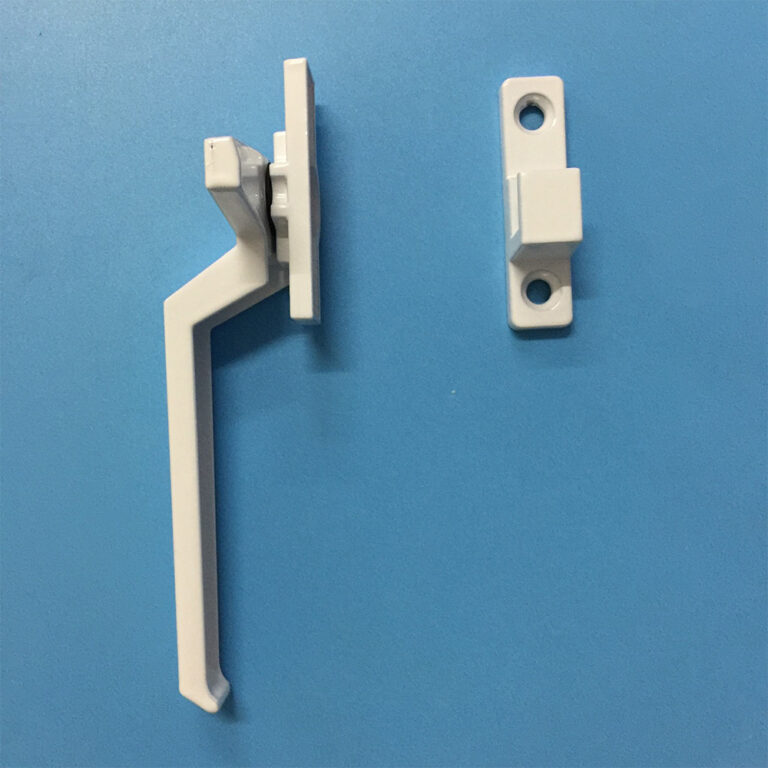
Projecting nose closes over a wedge
A wedge fixed to the frame
Step height, nose length, handing, wedge position
Ordering without measuring step height
Two of these entries are worth separating from the rest. “Espag” and “spindle drive” overlap heavily, because an espag handle normally uses a spindle. Cockspur handles don’t drive a gearbox at all. Both points matter when a buyer lists the order or quote requirements.
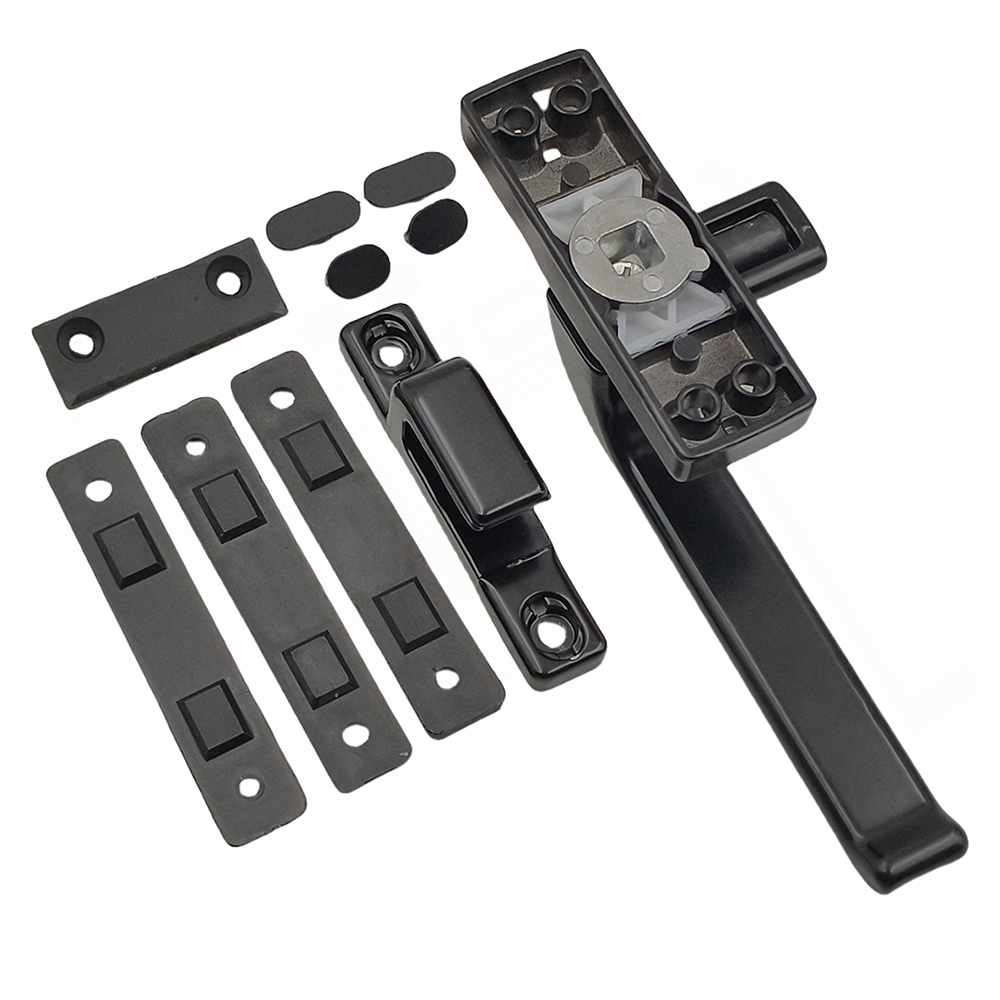
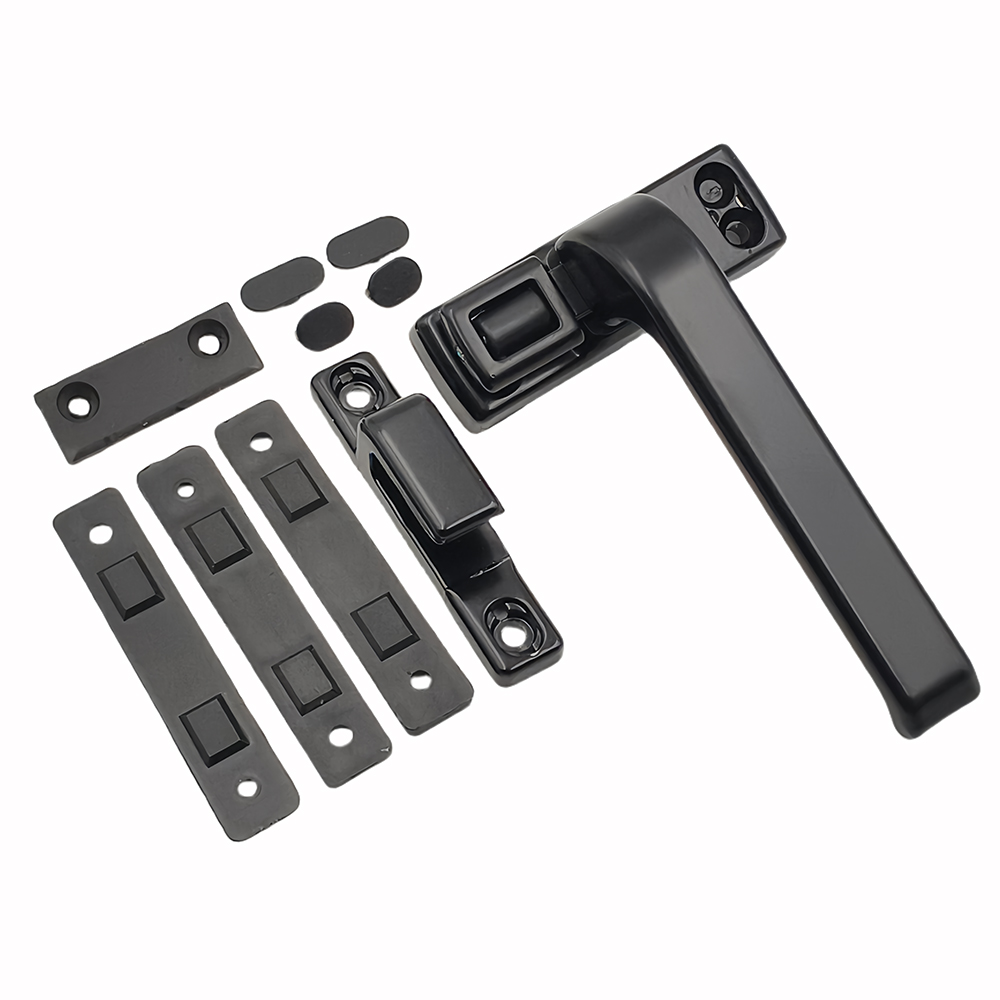
A cam handle turns a shaped cam behind a keeper and pulls the sash against the gasket. In an over-centre design, the linkage passes beyond its dead-centre position during the last part of closing. After that point, the reaction force from the compressed gasket helps hold the handle shut instead of pushing it open.
The performance of a cam handle depends on the whole closed assembly, not the handle alone. Profile tolerance, coating thickness, keeper position and gasket compression all affect where the cam lands. CHIER’s article on cam handle grip range and over-centre action treats grip range as the distance the latch must bridge when the sash is closed under normal gasket compression.
A buyer can use that principle in practice. Measure the closed assembly on several finished windows rather than relying on one nominal dimension. If the measured spread is wider than the handle’s adjustment, one of three things has to change: the cam offset, the keeper, or the handle design.
Two failure patterns show up with cams:
Too loose: the sash rattles and the gasket is under-compressed.
Too tight: the lever binds near the end of travel. A handle that turns smoothly with the sash open but binds when closed points to a closed-assembly problem, not a defective handle.
The keeper side matters as much as the handle side. Keeper height controls whether the lock point enters the keeper cleanly. Pull-in controls how hard the sash is drawn against the gasket. Keeper height and pull-in alignment covers how the two interact and why moving a keeper to hide sash sag only delays the fault.
Espag and Spindle-Drive Handles: The Common Standard That Still Needs Measuring
An espag handle turns a spindle that drives a gearbox. The gearbox moves a strip with several cams or rollers around the sash edge. This is the most widely specified arrangement on modern uPVC casements. ERA says espagnolette handles are the most widely specified for modern PVCu casement windows, while it lists cockspur handles for older-style windows.
The 7 mm and 43 mm reference points
Buyers often meet two figures: a 7 mm square spindle and 43 mm fixing centres. NiCo’s standard espagnolette specification lists a 7 mm square spindle drive and handle fixing holes at 43 mm centres. It also lists lockcase backsets of 20 mm or 22 mm. That is one manufacturer’s product specification. It is useful as a reference, but it does not set a rule for every gearbox.
Too short: the spindle engages the gearbox only partly, so the lock may travel incompletely or drive intermittently.
Too long: the spindle can reach the end of the gearbox cavity before the handle base seats. Tightening the screws then forces the base against an internal stop.
A useful test: if the handle gets easier to turn when its fixing screws are slightly loosened, check spindle length and mounting geometry before blaming the gearbox.
Rotation, detents and gearbox travel
A handle’s rotation angle does not tell you how far the locking points travel. Many espag and tilt-and-turn systems use defined positions about 90° apart, but the sequence changes between systems. Handle rotation and detent positions explains why a satisfying click at the end of travel does not prove the gearbox has reached full output travel. For an OEM project, ask for the motion diagram: operating angle, stop positions and the output travel of the mating hardware.
Fork-Drive Handles: Check the Receiving Mechanism
A fork-drive handle uses two prongs under the base instead of a square spindle. Many casement handles share a visible lever shape across both interfaces, so you can’t tell them apart from the front. ERA lists aluminium fork drive handles as a separate category for aluminium window profiles.
CHIER’s tapered-lever casement window handle with a dual-prong fork is a representative example. Its product page describes a tapered rotating lever, a rounded rectangular base and an exposed dual-prong fork. It lists white, silver-gray and black options. The page also says compatibility depends on more than exterior geometry. It asks buyers to confirm fork width, spacing, projection and engagement direction, plus base dimensions, mounting centres, required rotation, handing and clearance.
That checklist applies to any fork-drive handle. For a new design, add three items:
Photographs or a sample of the underside, so the supplier can see the interface.
Profile drawings and the receiving mechanism drawing.
The required lever rotation, because the fork has to travel through the same arc as the hardware.
Handing matters more with fork drives. A tapered or offset lever may be handed because of lever shape, fork orientation or frame clearance, so left and right versions can be mechanically different.
Cockspur and Tilt-and-Turn: Where They Fit
Cockspur handles don’t belong with the spindle and fork designs. They close a projecting nose over a wedge on the frame, so step height replaces spindle length as the critical dimension. They remain common on older uPVC and aluminium windows.
Tilt-and-turn handles control a multi-mode gearing system, so they should not be treated as ordinary espag replacements even when the fixing centres look the same. BSI’s catalogue entry for BS EN 13126-3:2023 covers durability, strength, security and functionality of handles for tilt-and-turn, tilt-first and turn-only hardware. It says the handles can also be used on other opening types. It does not apply to handles longer than 170 mm. So test evidence for a given handle depends on its length and its intended hardware, not only on the product category.
How to Choose Between Casement Handle Types
Choose in a fixed order. The first decision rules out the options that can’t work, and the later ones refine what remains.
Decision
Question to answer
What to verify
1. Drive interface
Does the mechanism take a spindle, a fork, a cam or a spur?
Photograph or sample of the underside; mechanism drawing
2. Travel
How far does the lever turn, and what output does the gearbox deliver?
Rotation angle, stops and detents, output travel
3. Closed-assembly fit
Does the handle land correctly on the keeper with the sash closed?
Grip range or step height, keeper height and pull-in at tolerance extremes
4. Environment
Will the hardware see coastal air or high humidity?
Substrate, coating system, corrosion-test basis
5. Operation
Can the user turn it comfortably, and does the lever clear reveals and screens?
Lever length, clearance, operating force, handing
On corrosion, check which test grade a datasheet cites. NiCo says its espagnolette passed BS EN 1670 Grade 5 (480 hours). ERA’s Maxim finishes meet Grade 3 (96 hours). The two grades are not interchangeable, and a project near the coast might call for the higher one. Ask for the grade and the test report.
Is a Universal or Multi-Spindle Handle the Better Option?
Not always. A multi-spindle pack reduces SKU counts and lets a distributor cover many replacement jobs with one part. That is its strength. But it also adds loose parts, relies on the installer picking the right spindle, and can leave the handle without a defined fit for a given system.
For an OEM or system programme where the gearbox and profile are fixed, a dedicated handle with a specified spindle or fork is usually the cleaner choice. It removes one installer decision and gives the quality team a single drawing to inspect. The trade-off is more SKUs when handing, interface, finish and lock function are multiplied together. The better option depends on whether you are selling into the replacement market or supplying one window system.
What Should Buyers Specify Before Requesting a Quote?
A supplier cannot quote a handle accurately from one front-view photo. An illustrative example: a buyer sends a photograph of a black lever and asks for “the same handle, matte black.” The supplier can match the colour, but cannot tell whether the handle needs a spindle, a fork or a cam, or what the fixing centres are. That leads to a sample cycle that tests the wrong interface.
Send this information:
Window type and opening direction, with profile material and sash dimensions.
Drive interface: spindle section and length, fork dimensions, cam geometry or cockspur step height.
Fixing centres and base footprint, plus clearance around the lever.
Handing: inline, left or right.
Rotation and travel: lever angle, stop positions, and any required detent.
Keeper and gasket data: grip range or step height at minimum, nominal and maximum, and the target compression.
Lock function: non-locking, key lock or button lock, and any restricted-access requirement.
Materials and finish: body, spindle or fork, fasteners, coating system, colour reference and corrosion-test grade.
Testing and documentation: cycle target, test standard if one applies, drawings and sample approval.
Photographs of the front, side, base and rear interface help, with a ruler or calliper in the dimensional shots. For custom work, CHIER’s OEM/ODM process starts with the application, profile section, mating hardware and drawings, then moves to sampling. The door and window handle manufacturing team is the place to send measurements and drawings for a compatibility review.
Frequently Asked Questions
What are the main casement window handle types?
The main types are cam, espag (spindle-drive), fork-drive and cockspur handles. They differ in how they connect to the locking mechanism, not in appearance. Identify the connection behind the handle base before comparing finishes or prices.
What is the difference between a spindle-drive and a fork-drive handle?
A spindle-drive handle turns a square spindle that fits a gearbox socket. A fork-drive handle uses two prongs that engage a receiving drive, commonly on aluminium profiles. Their critical dimensions differ: spindle section and length versus fork width, spacing and projection.
Is every 7 mm spindle espag handle interchangeable?
No. A 7 mm spindle and 43 mm fixing centres are common reference values, but spindle length, rotation, handing and clearance still vary. Measure the existing handle and the gearbox engagement depth before ordering.
What does over-centre action mean in a cam handle?
Over-centre action means the linkage passes beyond its dead-centre position during final closing. The gasket reaction then helps hold the handle shut instead of pushing it open. The final angle needs margin: stopping exactly on centre can let the handle spring back.
How do I choose spindle length for an espag handle?
Choose a length that gives full drive engagement without bottoming out before the handle base seats. Measure from the rear face of the handle base to the spindle tip on the working handle. If the original is uncertain, check the gearbox depth against its drawing.
Do cam handles and espag handles need different keepers?
Usually, yes. A cam handle lands on a keeper whose height and pull-in set engagement and gasket pressure. An espag system uses keeps along the sash perimeter, with cams that may adjust compression. Always verify against the specific hardware.
What should I send a supplier to get an accurate handle quote?
Send the opening type, drive interface dimensions, fixing centres, handing, rotation, keeper data, finish, lock function, quantity and photographs of the base and rear interface. Drawings or a sample make the quote faster and reduce sampling rounds.