Looking for hardware solutions that meet European / American standards?
Use this guided inquiry modal to move from a generic quote form to a clearer technical conversation. Buyers can choose whether they need pricing, CAD / 3D files, or OEM / ODM support before sharing contact details.
Compatibility-first design across door / window systems
Repeatable production with clear inspection checkpoints
Documentation and change control for long-running programs
Responsive engineering support for fit and field feedback
A multipoint door lock uses one operating input—normally a lever handle, key cylinder, thumbturn, or automatic trigger—to secure a door at several positions along its edge. Instead of relying on one latch and one deadbolt near the handle, the system may engage hooks, rollers, pins, round bolts, or shootbolts near the top, middle, and bottom of the door.
That sounds simple.
It isn’t.
The strip matters.
Because every hook, roller, bolt, and latch is mechanically linked through a narrow assembly that must tolerate door sag, frame movement, gasket pressure, temperature changes, manufacturing variation, and installation error without turning the handle into a pry bar.
So why do buyers still approve one from a front-view photograph?
My blunt answer is that the door hardware industry often sells multipoint locks as a bolt-count competition. Three points must be better than one. Five must be better than three. Add another hook, print “high security” on the carton, and move on.
That logic is lazy.
A multipoint locking system only performs properly when the gearbox, faceplate, locking points, keepers, handle, cylinder, hinges, door profile, and frame preparation operate as one assembly. CHIER’s own multipoint door lock range reflects this compatibility problem: backset, handle-to-cylinder centers, faceplate dimensions, spindle follower, point positions, and keeper layout all have to be checked together.
The Five-Second Explanation of a Multipoint Lock
When the door closes, the central spring latch normally enters its strike or keeper and holds the leaf against the frame.
The user then lifts the handle, turns the key, rotates a thumbturn, or activates another input. Inside the gearbox, cams and gears convert that rotational input into vertical or horizontal movement. Connecting strips or rods transfer the motion to remote locking points. Those points enter their corresponding keepers, pulling or holding the door against the frame.
On many residential lift-lever systems, raising the handle deploys the remote locking points and turning the key secures the gearbox against reversal. Other designs are key-wind, lever-operated, automatic, motorized, or panic-exit compatible.
The sequence may look like this:
The door leaf closes.
The latch enters the central keeper.
The handle or key rotates the gearbox input.
The gearbox moves the connecting strips.
Hooks, bolts, rollers, or pins enter their keepers.
The cylinder or internal blocking mechanism prevents the system from retracting.
Unlocking reverses the sequence.
Every stage depends on alignment. A gearbox cannot compensate indefinitely for a sagging door, and a strong hook cannot secure anything if its keeper sits 3 mm too high.
Multipoint Door Lock Components and What They Actually Do
Component
Mechanical function
Common failure symptoms
What must be verified
Gearbox or lock case
Converts handle or cylinder rotation into latch, deadbolt, and strip movement
Drooping handle, grinding, incomplete travel, key rotation without point movement
Backset, centers, spindle size, case depth, handing, connector geometry
Faceplate
Mounts and aligns the lock assembly along the door edge
Spindle section, projection, spring assistance, fixing centers
Cylinder or thumbturn
Authorizes or blocks locking and unlocking
Key binds, cylinder rotates without locking, deadbolt failure
Euro profile or other format, length, cam type, screw position
The Gearbox: The Transmission at the Center
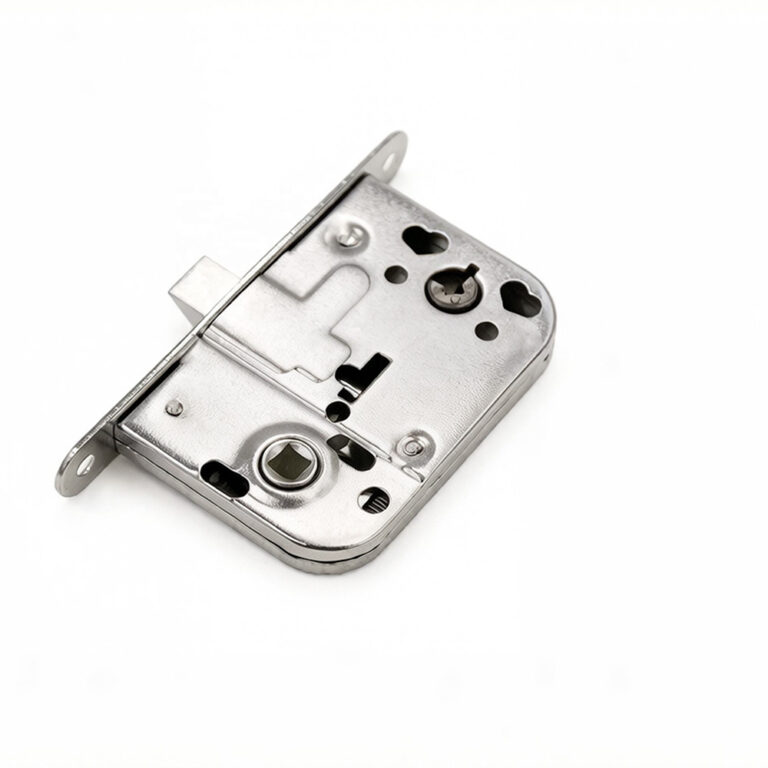
The multipoint lock gearbox is the central transmission case inside the door edge. It normally contains the spindle follower, cylinder interface, latch mechanism, springs, cams, gears, and sometimes a central deadbolt.
When the handle rotates the square spindle, the spindle follower turns inside the gearbox. That movement retracts the latch or drives the mechanism that moves the remote locking points. When the cylinder cam rotates, it may throw a deadbolt, block the gearbox, release the mechanism, or perform several of those actions in sequence.
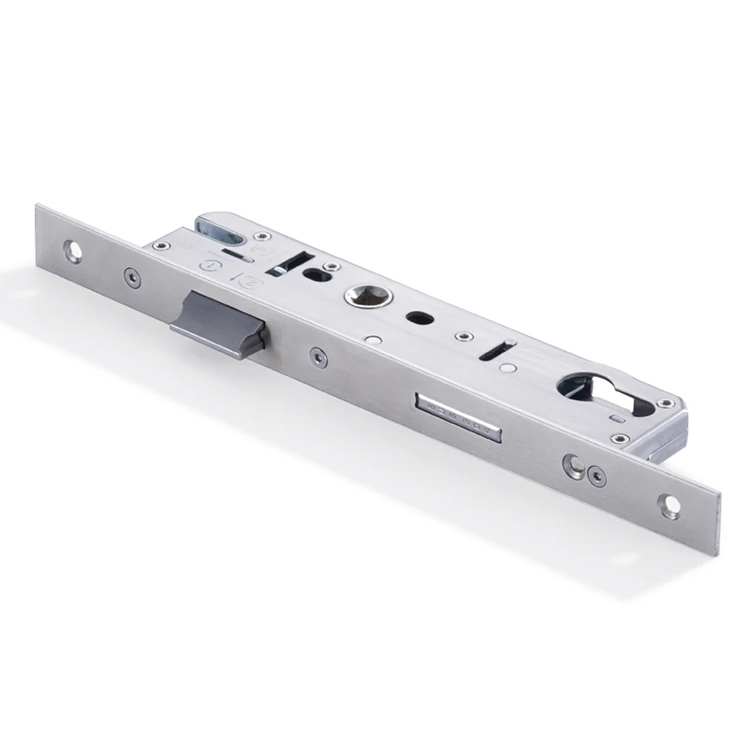
A typical narrow-faceplate multipoint lock gearbox combines a spring latch, separate deadbolt, square spindle follower, and Euro-profile cylinder opening. Even within that apparently familiar layout, the backset, centers, faceplate dimensions, case depth, handing, connector positions, and keeper arrangement still determine compatibility.
Here is the hard truth: “The gearbox looks the same” means almost nothing.
Two gearboxes can share the same silver finish and rectangular case shape yet differ in backset, spindle height, cylinder centers, screw positions, deadbolt throw, connector travel, or handing. A 2 mm difference at the connector can prevent a remote hook from reaching its keeper.
And yes, that tiny error becomes a large warranty claim.
The Faceplate: More Than a Metal Cover
The multipoint lock faceplate is the long metal strip visible along the door edge. It supports the central gearbox, guides remote locking elements, provides fixing locations, and establishes the installed position of each component relative to the door profile.
Some faceplates are flat. Others have rounded, U-shaped, stepped, or profile-specific cross-sections. Width and thickness matter, but so do countersink positions, screw spacing, end cuts, corner radii, surface treatment, and the distance between the faceplate datum and each locking point.
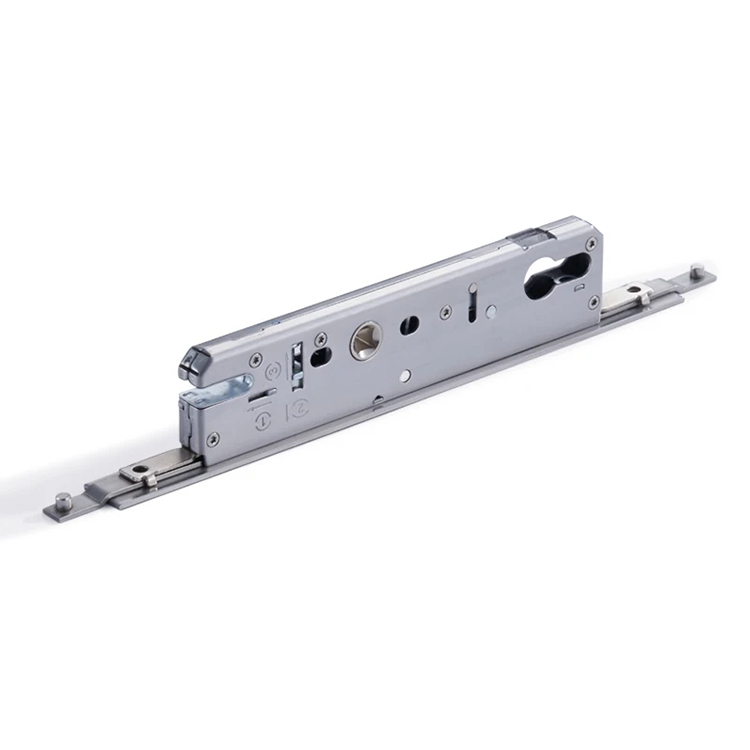
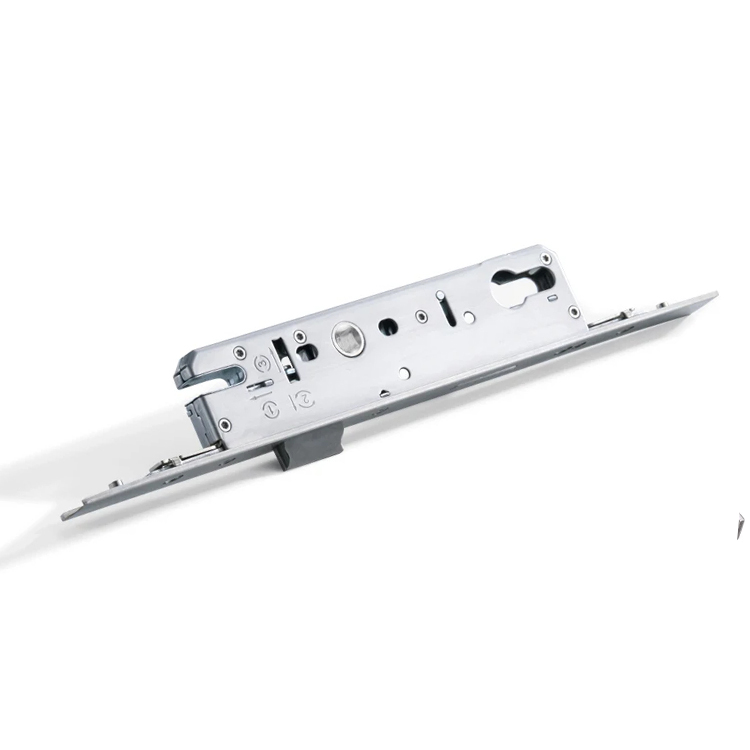
A long strip can also include upper and lower extension sections connected to the central gearbox. CHIER’s extended-strip lock with a central gearbox illustrates this arrangement: the gearbox, latch, bolt, linked sections, strip length, end travel, and keeper positions have to be treated as one door-edge system.
A faceplate that sits proud of the door edge may scrape the frame. One installed too deeply may prevent the hooks from reaching their keepers. Loose faceplate screws allow movement, while overtightened screws can distort a thin strip or pull it into an uneven routing channel.
Small errors compound.
That is how a smooth sample becomes a stiff production door.
Locking Points: Hooks, Rollers, Bolts and Pins
The phrase door locking points covers several mechanisms, and they do not all perform the same job.
Hook bolts project outward and then engage behind a frame-side keeper. Their shape can resist separation of the door and frame, provided the keeper is reinforced and correctly positioned.
Round bolts or pins project into holes or boxed keepers. They provide direct restraint but require accurate alignment.
Rollers and mushroom cams often contribute to pull-in and gasket compression. Some are adjustable, allowing installers to change compression within a limited range.
Shootbolts travel vertically into the head or sill. They may be used on tall doors, French-door arrangements, or systems requiring top-and-bottom restraint.
Central deadbolts secure the area near the gearbox and may also block the rest of the mechanism.
The UK National Protective Security Authority’s guidance for higher-risk applications advises considering multipoint systems with a deadlock and at least two hook bolts. That is useful guidance, but the phrase “consider” matters: the complete doorset, frame, glazing, cylinder, hinges, installation, and egress requirements still determine actual performance. See the NPSA guidance on strengthening doors and windows.
A twin-hook multipoint door lock makes the geometry easy to see. Each hook needs the correct projection, direction, spacing, and keeper depth. A hook that strikes the edge of its keeper is not “extra security.” It is extra friction.
Keepers: The Components Buyers Ignore Until the Door Fails
A multipoint lock keeper, also called a strike, receiver, or frame-side keep, is the component that accepts a latch, hook, roller, bolt, or pin.
Keepers determine where the moving components stop. They also influence compression, rattle, closing effort, pull-in, and the amount of clearance available when the door expands, contracts, drops, or twists.
They are not passive holes.
A hook keeper must allow the hook to enter and rotate or rise behind the retaining surface. A roller keeper must provide the correct ramp and compression position. A bolt receiver needs enough depth to accept full projection without bottoming out.
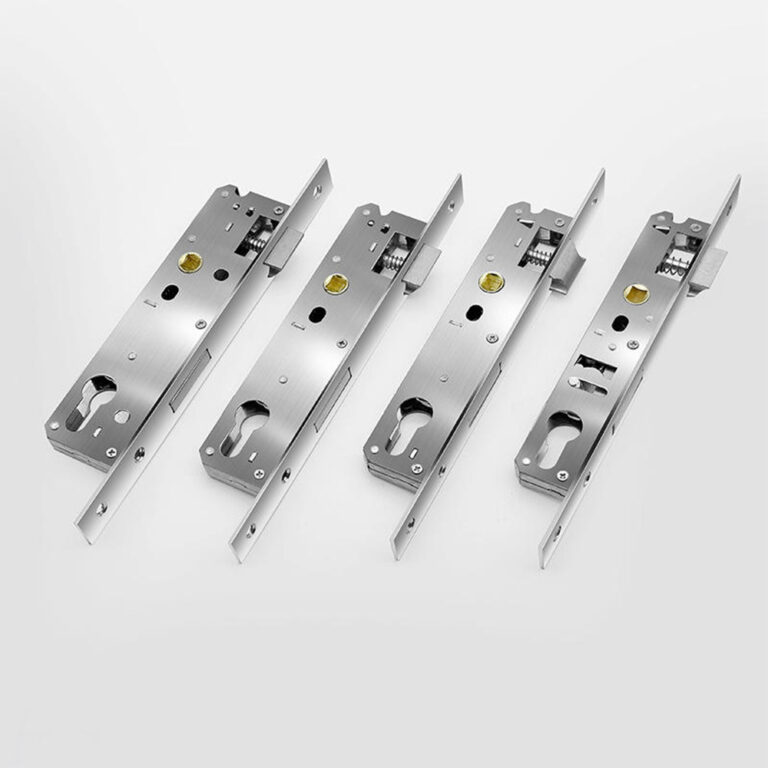
The four-bolt multipoint lock with its matching keeper set shows why both sides belong in the specification. The lock has four projecting bolts and a latch, while the frame needs a compatible strike plate and recessed receiver with matching spacing and depth.
I consider any multipoint lock quotation without keeper details incomplete.
The factory may have produced the lock perfectly. The installer may have fitted it accurately. But when a generic keeper from another system is substituted at the last moment, the handle force rises, the bolts rub, and everyone blames the gearbox.
What Happens Inside the Door When You Lift the Handle
Imagine a lift-lever multipoint door lock.
The lever turns an 8 mm square spindle. The spindle rotates the gearbox follower. A cam or gear train translates that rotation into linear strip travel. The upper strip moves upward; the lower strip moves downward, or both move according to the mechanism’s layout.
Remote hooks or bolts extend into their keepers. Rollers travel along keeper ramps and pull the leaf against the weather seals. The user then turns the cylinder, which throws a deadbolt or blocks the gearbox so that the handle cannot retract the locking points from outside.
That is the theory.
Real doors add resistance at every interface:
Gasket compression pushes the leaf away from the frame.
Door weight loads the hinges and changes point height.
Thermal movement changes the relationship between the leaf and frame.
Paint, debris, swarf, and sealant reduce keeper clearance.
Over-tightened fixing screws distort strips or cases.
Incorrect spindle length side-loads the follower.
Poor handle return springs leave the lever and latch partly displaced.
This is why smooth open-door operation matters. It gives the technician a baseline before frame engagement adds another set of forces.
The Fastest Way to Diagnose a Multipoint Door Lock
Test it with the door open.
Seriously. Start there.
Operate the handle and key several times while the door leaf is completely clear of the frame. Do not force anything. Watch every hook, roller, pin, and bolt. Confirm that each point reaches full travel and returns fully.
Then repeat the test with the door closed.
If It Works Open but Becomes Stiff When Closed
The gearbox is at least capable of moving the mechanism without frame resistance. The likely problem is alignment, keeper position, door sag, gasket pressure, frame movement, or local interference.
Marking compound, removable tape, or a dry-erase marker on the locking points can help identify contact locations. Check the hinge side before moving every keeper. A dropped door can make all upper and lower points appear incorrectly positioned at once.
If It Is Stiff with the Door Open and Closed
Suspect an internal or door-edge problem. Possible causes include a failing gearbox, bent faceplate, damaged connecting strip, seized locking point, incorrect handle spindle, loose internal fastener, contamination, or an incompatible replacement component.
Do not “fix” this by grinding the keepers wider. The frame is not causing resistance when the door is open.
If the Handle Moves but the Locking Points Do Not
The follower, cam, gear, connector, or strip link may have failed. Free-spinning or unusually light handle movement often indicates that input motion is no longer reaching the rest of the assembly.
If Only One Point Misses Its Keeper
Check that point’s height, projection, local strip condition, keeper location, and frame preparation. One local failure does not automatically justify moving every keeper.
If the Key Becomes Hard to Turn
First determine whether the key is retracting a latch, throwing a deadbolt, blocking the gearbox, or performing several functions. A cylinder that turns freely with the door open but binds when closed often points back to alignment or incomplete handle travel.
Security, Sealing and Accessibility Are Different Tests
Manufacturers love one-word claims: secure, airtight, accessible.
Those words are not interchangeable.
A multipoint door lock can improve restraint along the door edge and help maintain more even seal compression. It does not automatically make a weak door secure, an untested assembly compliant, or a poorly adjusted handle easy to operate.
The FBI’s preliminary national figures released on May 13, 2026, estimated that U.S. property crime fell 12.4% from 2024 to 2025. That is encouraging, but a national trend does not tell an architect, fabricator, or homeowner whether one specific doorset will resist attack. Read the FBI’s preliminary 2025 crime release.
Security claims should be tied to complete doorset testing and applicable standards. In the UK market, Secured by Design explains that new door assemblies fall under PAS 24, while related cylinders and hardware may be assessed under standards such as TS 007:2014+A2:2018. See its locks and associated hardware guidance.
Accessibility introduces another engineering constraint. Under the U.S. 2010 ADA Standards, door handles, pulls, latches, locks, and other operable parts must comply with Section 309.4. Operable hardware must work with one hand, without tight grasping, pinching, or twisting, and activation force is limited to 5 lbf, or 22.2 N, where the provision applies. Hardware is generally positioned 34 to 48 inches, or 865 to 1,220 mm, above the finished floor. Read the 2010 ADA Standards for Accessible Design.
That is not theoretical paperwork. In a 2015 settlement involving Quincy, Massachusetts, the U.S. Department of Justice required entrance knob hardware to be replaced with hardware operable using one hand without tight grasping, pinching, or wrist twisting. The Quincy accessibility settlement is a useful warning for anyone treating handle effort as a minor detail.
A separate DOJ settlement involving AmericInn/Wyndham identified a connecting-door deadbolt that required tight pinching and twisting, requiring correction under Sections 309.4 and 404.2.7. That door-hardware enforcement example shows how a technically functional lock can still fail a usability requirement.
So no, the “best multipoint door locks” are not automatically those with the most locking points or the heaviest handle.
The best system is the one that matches the door geometry, tested security route, required operating force, corrosion exposure, seal design, production tolerance, egress function, and expected duty cycle.
What to Measure Before Ordering a Replacement
Do not begin with the brand stamped on the faceplate. Begin with dimensions and operation.
Record the following:
Overall faceplate length, width, thickness, and profile
Gearbox backset
Handle-spindle to cylinder-center distance
Gearbox case height, depth, and width
Spindle follower size and position
Cylinder format and fixing-screw position
Latch orientation and handing
Deadbolt dimensions and throw
Type and location of every locking point
Distance between locking-point centerlines
Hook, roller, pin, or bolt projection
Extension-strip connection geometry
Keeper type, height, depth, and fixing positions
Door and frame profile sections
Handle fixing centers and spindle length
Required finish and corrosion resistance
Opening direction and inward- or outward-opening configuration
Photograph the complete strip beside a tape measure. Photograph the gearbox from both sides. Photograph every locking point and keeper. Record dimensions from one consistent datum rather than measuring each feature from whichever end happens to be nearest.
But do not assume a photograph proves compatibility.
For OEM or replacement development, the sensible route is to send the door section, frame section, lock drawing, keeper layout, operation sequence, annual volume, finish requirement, and known field failures together. CHIER’s OEM and ODM multipoint lock process specifically treats the backset, centers, faceplate, locking points, and gearbox interface as one specification rather than independent catalogue choices.
FAQs
What is a multipoint door lock?
A multipoint door lock is a door-edge locking system in which one handle, key cylinder, thumbturn, or automatic trigger drives two or more locking points—such as hooks, rollers, round bolts, pins, or shootbolts—into frame-mounted keepers, distributing restraint and compression along the door instead of relying on one central lock.
The complete system normally includes a gearbox, faceplate, connecting strips, locking points, keepers, handle, spindle, and cylinder.
How do multipoint door locks work?
A multipoint door lock works by converting rotational input from the handle spindle or cylinder through a central gearbox into controlled linear movement, which shifts connecting strips or rods and sends the latch, deadbolt, hooks, rollers, pins, or bolts into matching keepers positioned along the door frame.
Some models require the handle to be lifted before the key turns. Others use key-driven, automatic, motorized, or panic-exit mechanisms.
Is the gearbox the same as the complete multipoint lock?
The multipoint lock gearbox is the central transmission case, not the entire lock; it contains the spindle follower, cylinder interface, cams, gears, springs, latch, and often a deadbolt, while the faceplate, extension strips, remote locking points, handles, cylinder, and frame-mounted keepers complete the full locking system.
Replacing only the gearbox is possible in some systems, but the connection geometry and operating travel must match.
Are more locking points always better?
More locking points are better only when each point aligns with a reinforced keeper and the gearbox can move the complete system without excessive handle force; extra hooks or bolts added to a flexible door, weak frame, poorly prepared profile, or unstable hinge system can increase friction and service failures without delivering proportional security.
Tested doorset performance matters more than an impressive bolt count.
How can I tell whether the gearbox or keepers are faulty?
A gearbox problem usually affects operation with the door open, while a keeper or alignment problem usually appears only when the door is closed; this open-door versus closed-door comparison is the fastest first diagnostic because it separates internal mechanism resistance from resistance created when the locking points engage the frame.
The test is not conclusive in every case, but it prevents many incorrect gearbox replacements.
Can I replace only the multipoint lock gearbox?
A multipoint door lock gearbox can sometimes be replaced without replacing the full faceplate and locking strip, but only when the backset, handle-to-cylinder centers, spindle position, case dimensions, connector geometry, latch handing, deadbolt travel, fixing points, and operating sequence match the existing assembly exactly.
Never assume two visually similar gearboxes are interchangeable.
Send the Geometry Before You Send the Purchase Order
Before approving a multipoint door lock, collect the gearbox dimensions, faceplate profile, locking-point coordinates, keeper details, door and frame sections, handing, handle geometry, cylinder format, operating-force target, finish, and annual quantity.
Then test the complete assembly—not just the loose lock on a workbench.
For replacement matching, OEM production, keeper development, or a new multipoint locking system, send CHIER your drawings and application details. A clear specification now is cheaper than grinding keepers, replacing gearboxes, and arguing over field failures later.