Looking for hardware solutions that meet European / American standards?
Use this guided inquiry modal to move from a generic quote form to a clearer technical conversation. Buyers can choose whether they need pricing, CAD / 3D files, or OEM / ODM support before sharing contact details.
Compatibility-first design across door / window systems
Repeatable production with clear inspection checkpoints
Documentation and change control for long-running programs
Responsive engineering support for fit and field feedback
On a narrow-stile aluminum door, backplate width is often the first dimension that decides whether a handle fits. The stile is the vertical extrusion that holds the lock, and on narrow profiles it leaves very little flat surface for a plate, its screws and a Euro cylinder cutout. A plate that suits a timber door can overlap the glazing bead or the gasket step, or leave its fixing screws with too little material to bite into.
This guide covers how to work out the usable width, which factors set the limit, and when a narrower plate stops being the safer choice. It also lists what to send with an RFQ so suppliers can quote a handle that fits the profile.
What Counts as a Narrow Stile on an Aluminum Door?
“Narrow stile” has no single worldwide definition, so the first job is to find out which profile you are dealing with. In North American storefront practice, Locksmith Ledger’s overview of aluminum stile glass doors gives rough stile sizes of 2″ narrow, 3½” medium and 5″ wide. It also says these figures describe the outer extrusion only and exclude the portion of the stile that retains the glass.
The visible stile face and the flat surface a plate can sit on are therefore different dimensions. A related Locksmith Ledger article on narrow-stile hardware puts narrow stiles at roughly 1¾” to about 2⅛” wide. That is about 44 to 54 mm. It advises measuring stile width and thickness before changing any lock hardware.
European and Asian aluminum systems use their own slim profiles, and their widths vary by system. Retail ranges give a sense of the market. Milla Poignées’ narrow-plate handle category lists models on 24 mm and 26 mm plates for narrow aluminum or PVC profiles. It describes narrow plates generally as 25–40 mm wide. These are retailer listings, not a standard. Treat them as evidence of what exists, not as limits that apply to your door.
How Wide Should a Handle Backplate Be on a Narrow Stile?
A backplate should be narrower than the flat, load-bearing face of the stile, with enough margin on both sides for tolerance and visual alignment. The margin is set by the profile system and the fabricator. There is no universal figure.
A simple check:
Maximum plate width ≈ usable flat face width − (2 × edge margin)
Here is an illustrative example, not a CHIER specification. Suppose a stile shows 50 mm of face. The glazing bead and gasket step leave about 38 mm of flat surface. A 26 mm plate then leaves 6 mm per side, which gives some room for extrusion tolerance, coating thickness and installer positioning. A 40 mm plate would not sit flat at all, even though it is labelled “narrow” by some retailers.
Several things change the result, so verify them against a physical profile section or drawing:
Factor
What it limits
What to verify
Flat face width
Maximum plate width
Width between bead, gasket or step edges, not overall stile width
Screw-boss or chamber position
Fixing centre and screw location
Where the profile can actually hold a screw
Cylinder cutout position
Plate length and PZ relationship
Cutout position against the lock’s cylinder centre
Lock backset and faceplate
Spindle position across the stile
Gearbox or lock case depth and faceplate width
Handle projection
Interference with frame, screen or adjacent panel
Installed envelope, including hand space
The Factors That Set the Real Width Limit
Usable flat face, not nominal stile width
Plates rarely fail because they are wider than the stile. They fail because they are wider than the flat zone inside the bead, gasket or step. Sections with a stepped face, a raised glazing pocket or a deep gasket channel can cut the flat zone well below the nominal stile figure. Ask for a dimensioned cross-section, not a product photograph.
Fixing position and what the screws bite into
On a thin extrusion, the plate must also put its screws where the profile can hold them. The multipoint lock interface guide makes this point. Narrow-stile aluminum profiles may need compact gearboxes and narrow faceplates, and fixing screws need something meaningful to engage. A thin wall does not behave like solid timber.
A long narrow plate with a cylinder cutout puts three things on one strip: the spindle hub, the cutout and the fixing holes. All three must align with the lock below. A plate may be narrow enough for the stile and still have a cutout that sits at the wrong height for the lock’s PZ centres. The cutout also takes up part of the plate width, which reduces the material around the fixings. Ask the supplier to confirm the spacing between cutout, spindle and screws, not only the overall width.
Backset and faceplate at the door edge
The plate sits on the face of the door, but the lock sits inside the edge. Backset is the distance from the door edge or faceplate to the spindle centreline, and it decides where the handle lands across the stile. On a narrow stile this is a tight window. If backset puts the spindle too far from the centre of the flat face, the plate lands off-centre even when its width is acceptable.
For measuring the lock side, see the guide to how to measure a multipoint door lock’s backset, PZ, faceplate and centres. It lists the data to record: backset, PZ centres, faceplate width and length, spindle size, handle fixing centres, overall strip length and the position of every hook, roller or bolt. Locksmith Ledger notes that aluminum stile mortise locks come in three standard backsets (31/32″, 1⅛” and 1½”), which shows how small the differences can be.
Projection and clearance near the frame
A narrow plate does not guarantee a tight installed envelope. A lever on a narrow-stile door can sit close to an insect screen, a fixed glazed panel or a deep reveal. CHIER’s guide to projection and clearance near frames, screens and adjacent panels treats clearance as a system envelope, not a single catalog dimension. It also points out that tolerances stack. An illustrative 14 mm gap can shrink to roughly 4 mm once gasket build, fixing seat variation, panel position and frame installation variance are added.
Check clearance at the worst combination of tolerances, with the lever fully rotated and a hand on the grip. Not just the nominal CAD position.
Is the Narrowest Backplate Always the Best Choice?
No. The narrowest plate that fits is often not the best plate for the door, for three reasons.
Fixing margin. A very narrow plate pushes the screws toward its edges. If the profile’s usable screw zone is wider than the plate, the plate can look right and still fail to reach the right screw position.
Cutout and hub strength. Narrower plates leave less material around the cylinder cutout and spindle hub. Whether that matters depends on the material, the thickness and the supplier’s construction, so ask about it.
The defensible rule: choose the narrowest plate that still lines up with the screw positions, covers any old preparation, and clears the bead and gasket with margin. Past that point, a narrower plate adds risk and little else. For OEM projects, the same logic applies at design stage: set plate width from the profile’s usable face and screw zone, not from a visual preference for slimness.
Comparing Plate Options for Narrow Stiles
This is a qualitative comparison. It does not include measured data, and the right option depends on the profile.
Option
Best suited to
Main advantage
Main risk
Verify before ordering
Long narrow backplate with cylinder cutout
Narrow profiles needing handle and Euro cylinder on one plate
Operating and locking interfaces aligned on one plate
Plate and cutout must match PZ and screw zone exactly
Start with the profile, then the lock, then the handle.
Stile cross-section. Get a dimensioned drawing or a physical section. Record overall stile width, flat face width, bead or gasket step positions, screw port locations and wall thickness at the fixing points.
Lock data. Record backset, PZ centres, faceplate width, spindle size and overall strip length using the multipoint measuring guide linked above.
Existing handle data (for replacements).Measuring PZ centres, fixing centres and spindle size is covered in CHIER’s measuring guide. It also recommends recording the position of each screw relative to the spindle, because handles with the same overall fixing centres can place the spindle differently. Record plate length, plate width and projection too.
Door thickness. Handle fixings and spindle length depend on it.
Environment. Note any adjacent frame, screen, fixed panel or reveal that limits projection.
Photograph both sides of the door and the edge strip, with a ruler beside the part in question.
Common Failure Modes
Plate overlaps the bead or gasket step. The plate rocks or leaves a gap. Cause: the buyer compared plate width with stile width, not with flat face width.
Screws land in void or miss the screw port. Fixing centres match the old handle, but the new plate places the spindle differently between the screws.
Cutout misaligned with the cylinder. PZ was checked but the cutout position on the plate was not.
Spindle lands off-centre because of backset. The handle works mechanically but looks wrong, or the lever contacts the frame.
Lever contacts a screen or adjacent panel. Clearance was checked in the static position only.
“Close enough” on a lock interface. A 92 mm handle can still fail against a 92 mm lock because spindle size, fixing pattern, plate width, cylinder projection or profile clearance differs, as the door handle and lock compatibility checklist explains.
What Should You Send Before Requesting a Quote?
A quote based on “black narrow plate handle, 92 mm” is a guess. Send:
Profile cross-section drawing or sample, with flat face width and screw port positions marked
PZ centres, fixing centres, spindle size and length
Door thickness and handing
Lock make, model or faceplate code, backset and faceplate width
Cylinder type and position
Required plate width and length range, and any maximum projection
Finish, quantity, packaging and target market
Photographs of the door, lock edge and any nearby frame or screen
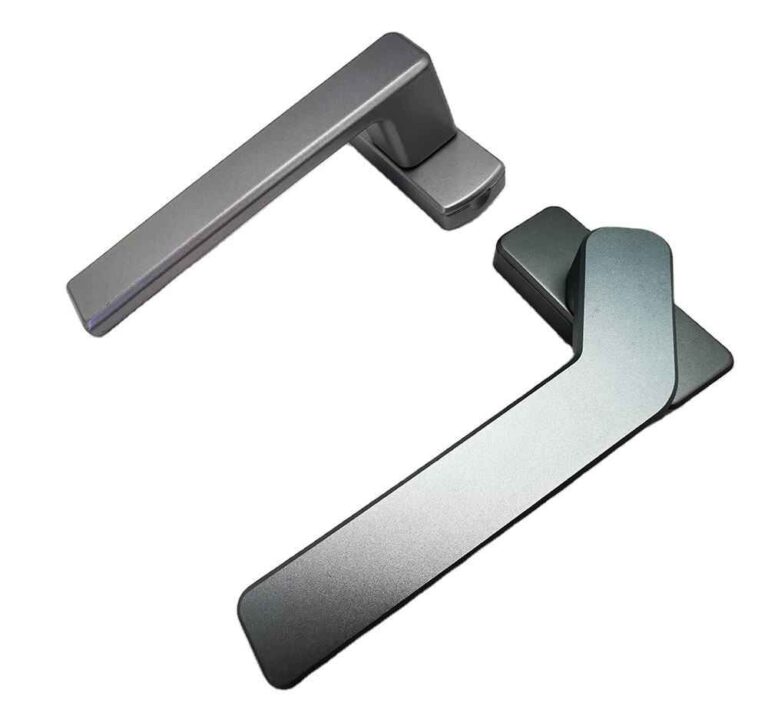
For a narrow-profile project, the narrow backplate lever door handle set with a Euro cylinder cutout is a useful starting reference. CHIER’s page describes a black lever set with a slim long backplate, straight rectangular levers, a Euro-profile cylinder cutout below the handle hub, and a square spindle hub with a twin-spring cassette in each plate. The page does not publish plate dimensions. It tells buyers to confirm mounting centres, backplate dimensions, spindle interface, handing, cylinder position and door-profile fit, and to send a drawing or sample for review. It also says the handle should not be treated as a complete locking system until the spindle, cylinder, lock case and fixings are confirmed. Request the dimensioned drawing and check it against your profile before ordering.
Frequently Asked Questions
What backplate width fits a narrow-stile aluminum door?
It depends on the flat face of the profile, not the nominal stile width. Subtract the bead or gasket step and an edge margin from the flat face. Retail ranges list 24–26 mm plates for some narrow profiles, but confirm against your section.
Is stile width the same as the flat face where the plate sits?
No. Stile width is usually quoted for the outer extrusion, and it excludes the portion that retains the glass. The flat face can be narrower once the bead, gasket pocket or step is deducted. Measure the flat zone directly.
Does a narrower backplate always fit better?
Not always. Very narrow plates can push fixings toward the edge, leave old holes exposed on replacements, and leave less material around the cutout and hub. Choose the narrowest plate that still aligns with screw positions and clears the bead.
Do I need to check PZ centres as well as plate width?
Yes. Width decides whether the plate sits on the stile. PZ centres decide whether the lever and cylinder cutout align with the lock. A plate can have the right width and the wrong PZ, and fixing centres are a separate check.
How does backset affect handle fit on narrow aluminum stiles?
Backset sets where the spindle sits across the stile. On a narrow flat face, a backset that is slightly off can make the plate sit off-centre or bring the lever too close to a frame. Confirm it with the lock data.
What should I send a supplier to quote a narrow-stile handle?
Send a profile cross-section or sample, PZ and fixing centres, spindle size, door thickness, handing, lock and faceplate data, cylinder position, finish, quantity and photographs. A drawing with the flat face marked is the most useful single item.